Shop by Vehicle
 Track Order
 Contact Us
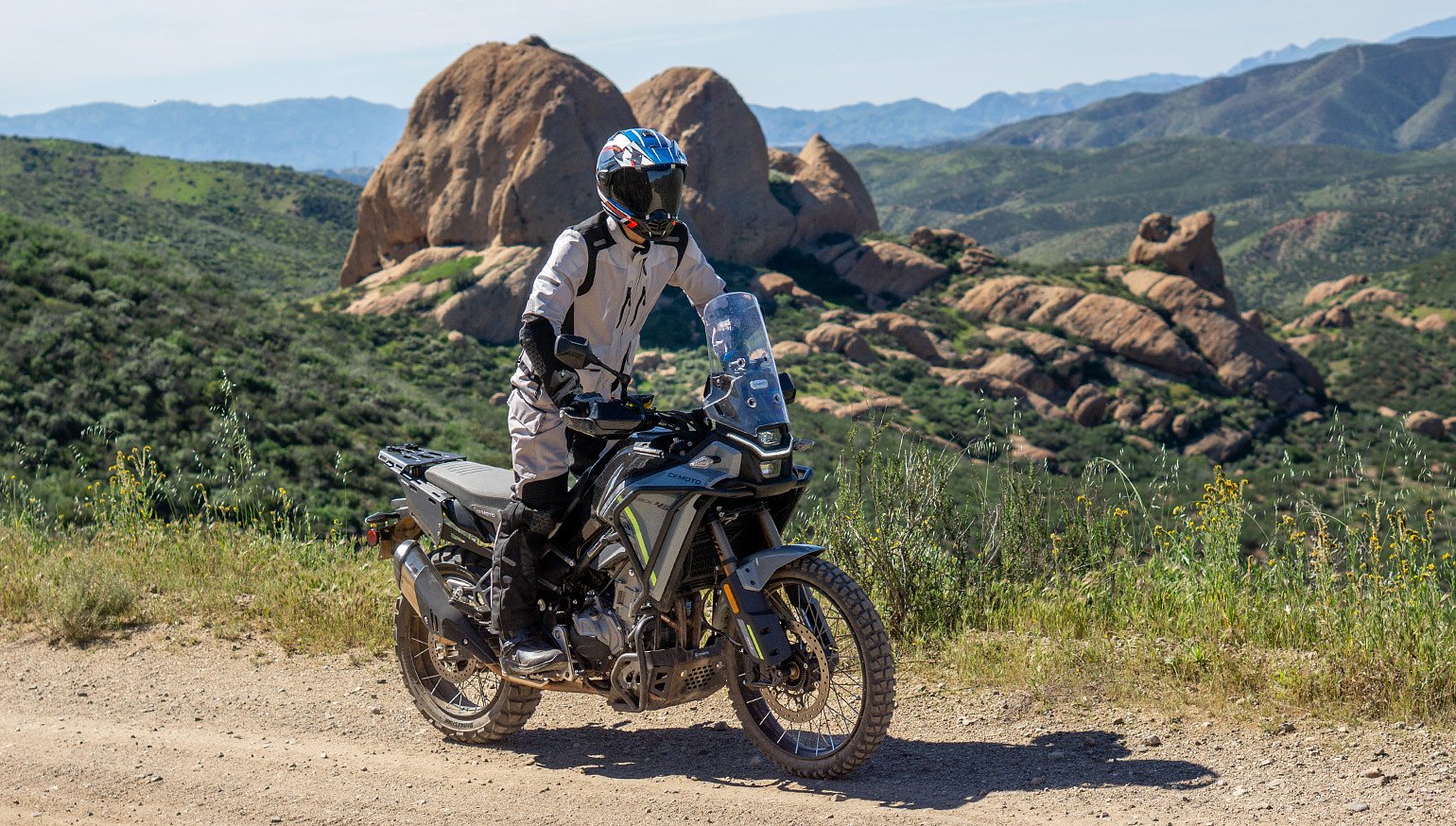
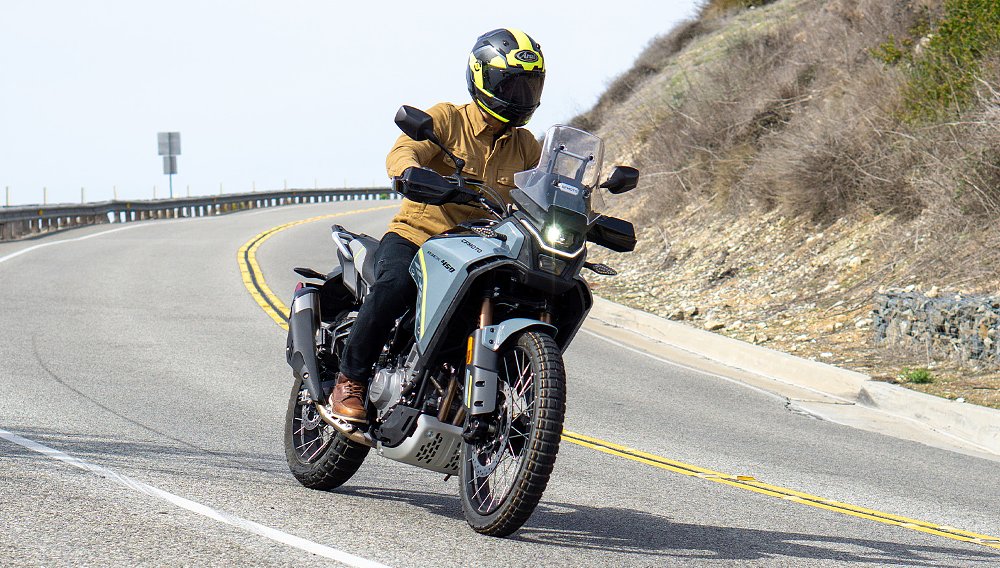
Many adventure bikes lay down the majority of their miles on the asphalt. By no means is that an insult. All ADVs can tackle a dirt road, but one quality prevents most owners from venturing too far down the unpaved path.
That quality is weight.
Your average dirt bike or dedicated enduro tips the scales at 250 pounds, give or take. Your average adventure model weighs 200 pounds more — if you’re lucky. Some flagship adventure-tourers are pushing 600 pounds (I’m looking at you, BMW R 1300 GSA). I don’t know about everyone else, but I prefer a lighter bike when maneuvering over tricky terrain. That’s why I thought the Ibex 450 would fare much better than its larger counterparts. I now know that my logic wasn’t completely sound.
Bulking up
I saw the “450” at the end of the Ibex’s nameplate and told myself, “Smaller number, smaller bike.” Makes sense, right? Not so fast, bub. Its seat height is lower than most ADVs, at 31.5 inches. Its wheelbase is shorter than most ADVs, at 59.25 inches. But when it comes to the Ibex’s mass, it’s a four-fifty, alright. As in, four-fifty on the scales.
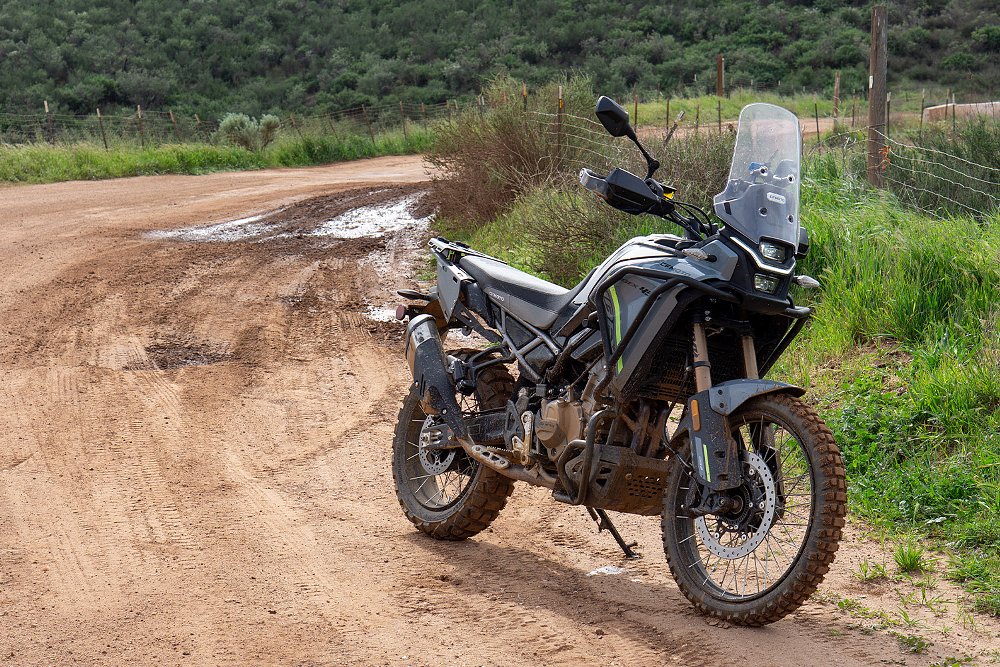
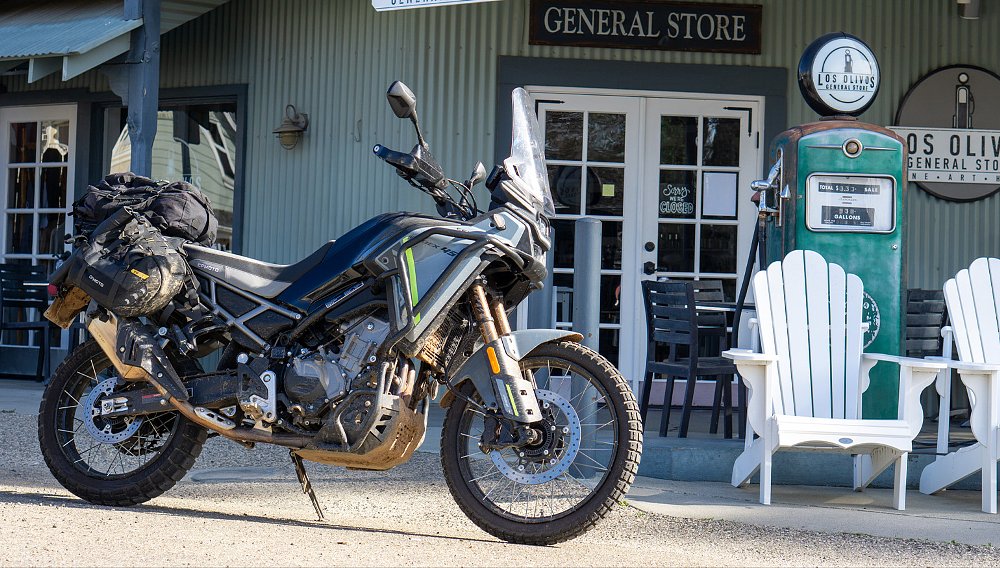
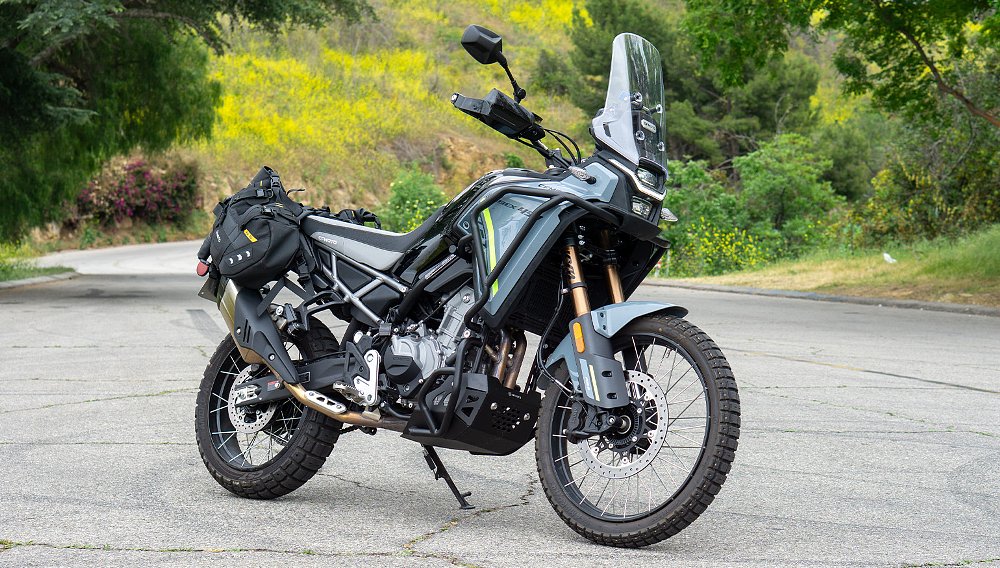
Measured at 426 pounds on the trusty RevZilla West scales, this little CFMOTO weighs about as much as a Ducati Scrambler. Kitted out with crash bars, a bash plate, and luggage, the Ibex is actually five pounds heavier than the 453-pound Ténéré 700 (wet) we weighed on our scales in 2024. In other words, where lbs. are concerned, the small-bore model verges on middleweight territory.
That might explain why netizens often brand the Chinese-made adventurer a “Baby Ténéré.” It’s meant as a compliment in most cases. That doesn’t mean the Ibex can do everything the T7 can. But if we’re looking at the glass half-full, it has several advantages over the Yamaha, too. Let’s hear the good news first, shall we?
Keeping a low profile
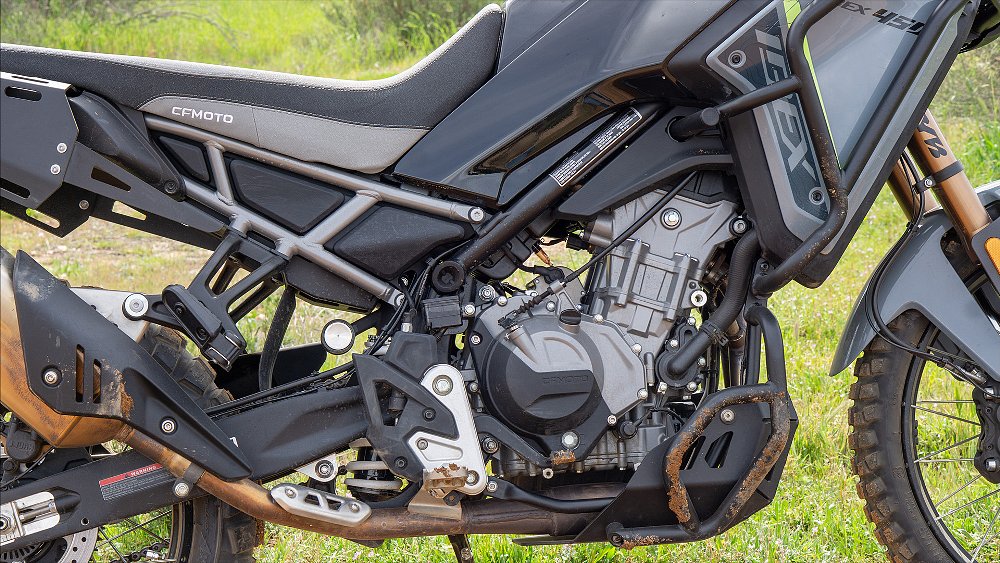
As previously established, the Ibex benefits from a low seat height. More specifically, 2.9 inches lower than the Ténéré’s. All this while matching the T7’s 7.9 inches of rear suspension travel and yielding just 0.4 inches of travel up front (7.9 inches versus 8.3 inches on the Ténéré). No, the Ibex’s 8.7 inches of ground clearance doesn’t equal the Ténéré’s 9.4 inches, but most people can’t flat-foot the Ténéré, either. It’s that accessibility that differentiates the Ibex, especially off-road.
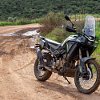
CFMOTO outfitted the mid-size ADV for trail excursions right out of the box. That’s what the 21-inch front and 18-inch rear tubeless spoked wheels suggest, anyway. The CST Ambro A4 tires that wheelset comes wrapped in may not share the name recognition of the Pirelli Scorpion Rally STRs they imitate, but they do the deed, regardless. Basically, the Ibex doesn’t shy away from the dirt path. Aboard the bike, neither did I.
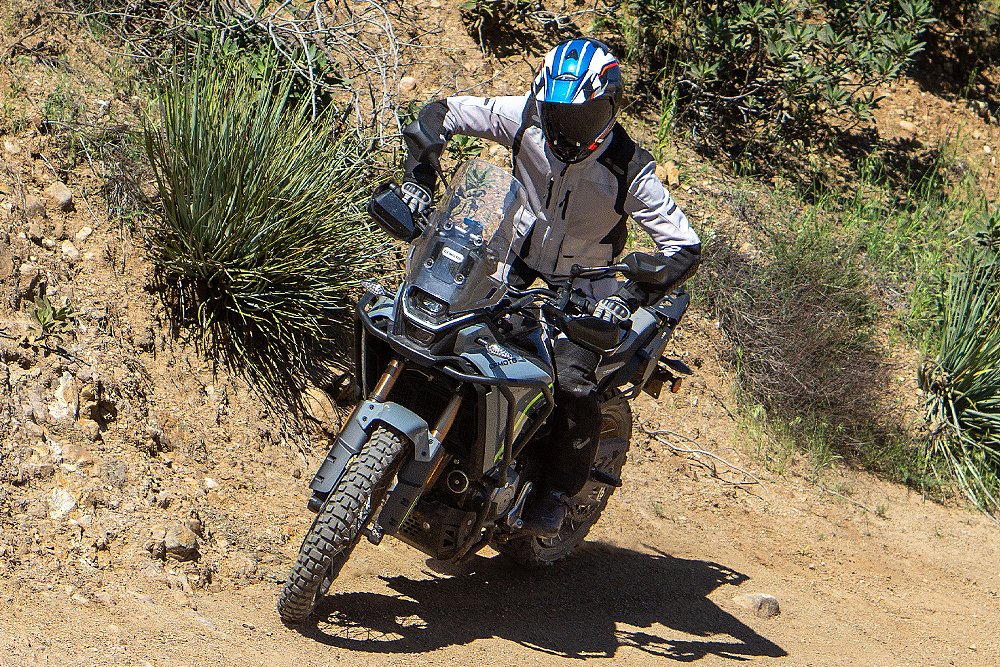
I’d rank my off-road skills somewhere between upper beginner and lower intermediate (and that’s being kind). I don’t actively avoid the trail, but I don’t seek it out, either. That all changed while testing the Ibex 450. I attribute much of that enthusiasm to the model’s user-friendly build.
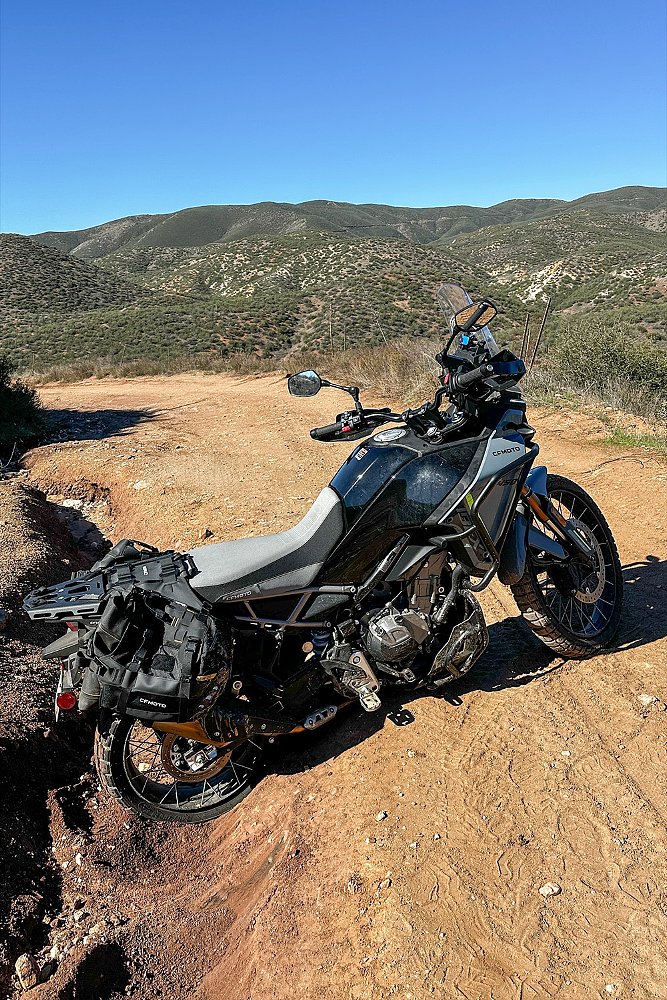
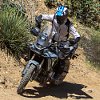
When I recount my off-road experiences on the Ibex, the adjective that comes to mind is: balanced. I could toss out synonyms like composed, controlled, planted. It’s all of those things, whether it’s blasting down a fire road, negotiating single-track, or picking through a rock garden. I attribute much of that balance to the model’s centralized mass. Sure, the Ibex is well over 400 pounds, but it carries much of that weight down low.
Unlike the T7, which is slender and tall, the Ibex 450 is broad-shouldered and compact. I’ve tipped over the Ténéré a time or two (or 10) in my day. It’s incredibly easy to do when you’re supporting the bike on the balls of your feet (not to mention a poor off-road rider to begin with). But dropping the T7 is only half the battle. Picking up the lanky ADV requires even more energy. The Ibex doesn’t suffer from that same tippy verticality.
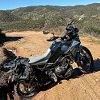
The only times I picked up the bike were when I tucked the front at the Tech-Air 5 Plasma launch and after purposely laying it on its side to get the rear wheel out of a rut. Lifting it in both instances was a cinch. Maybe that’s why I finally sought out the trail on the Ibex. Maybe that’s why I’ve recorded the majority of my off-road miles on the Ibex. In stock form, it’s both capable and confidence-building. Both approachable and playful. It’s only more so after a few upgrades.
Dressed to progress
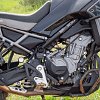
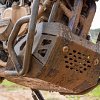
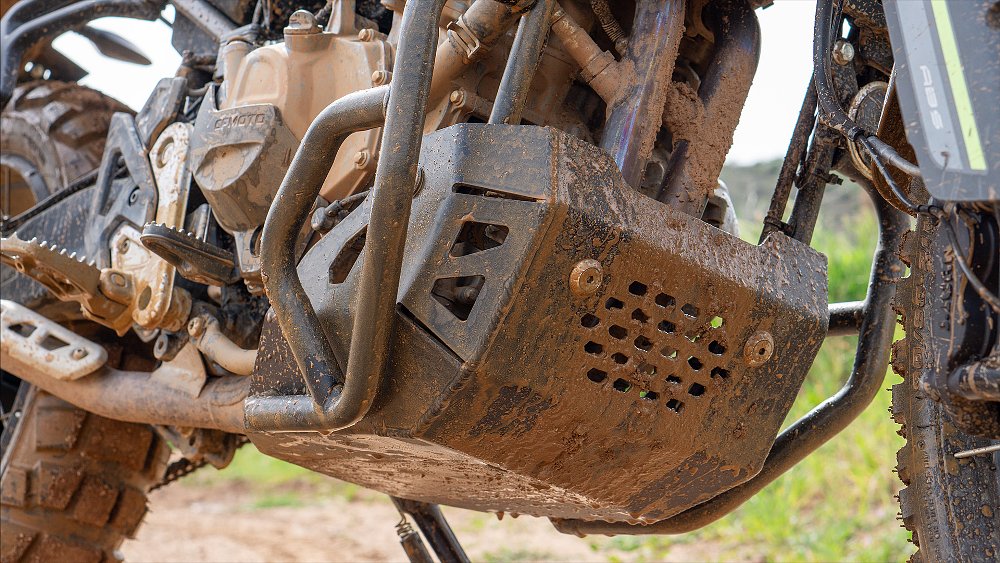
My initial road trip with the Ibex 450 revealed many of the bike’s strengths and shortcomings. Shortcomings that warranted an assortment of accessory add-ons. A tall windscreen and soft panniers supplemented the model’s touring pedigree. A brawny bash plate, case protectors, and engine guards provided peace of mind on the trail, but it’s the rally seat that made the immediate difference.
The seat's taller stack not only opened the legroom in the cockpit, but also preserved sure footing at a stop. It not only enhanced sit-down comfort, but also improved the knee touch points when standing. The latter of which enabled me to better manipulate the Ibex around corners and obstacles. Still, the cumulative impact of the trail-focused bolt-ons paled in comparison to a solid set of tires.
CST rates its Ambro A4 model as a 50% on-road/50% off-road tire. It behaves as such, too, providing sufficient (but not excellent) grip on both dirt and tarmac. By contrast, Bridgestone’s Battlax AdventureCross AX41 favors the unbeaten path, nudging that ratio to 40/60. That extra off-road performance doesn’t come without its on-road compromises, though.
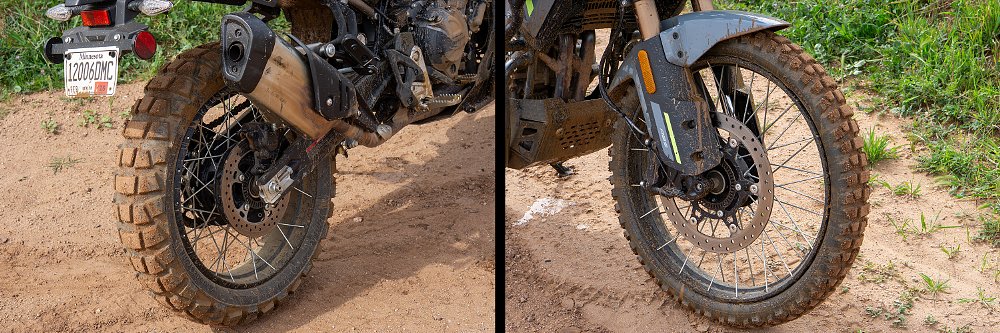
Anyone rolling on dirt-biased rubber knows they often come with added road noise and slight instabilities. The AX41 is no exception. I always wear earplugs. Always. If you don’t, you’ll want to order a pair along with the Battlaxs. Once they’re mounted, you’ll also want to avoid road seams, highway grooves, and thickly painted double lines, as the tires squirm like a hooked worm when rolling over them (at an oblique angle).
For all those drawbacks, I’d still swap for the Bridgestones every time. That’s because you can’t put a price on confidence in the dirt.
Finding the limit
There’s nothing like riding a motorcycle. That’s especially true when you find a state of flow. When you’re connecting corners with the utmost of ease. When your stressors, anxieties, and fears melt away. When you’re completely present. With AX41s spooned onto its tubeless wheels, the Ibex delivered that experience.
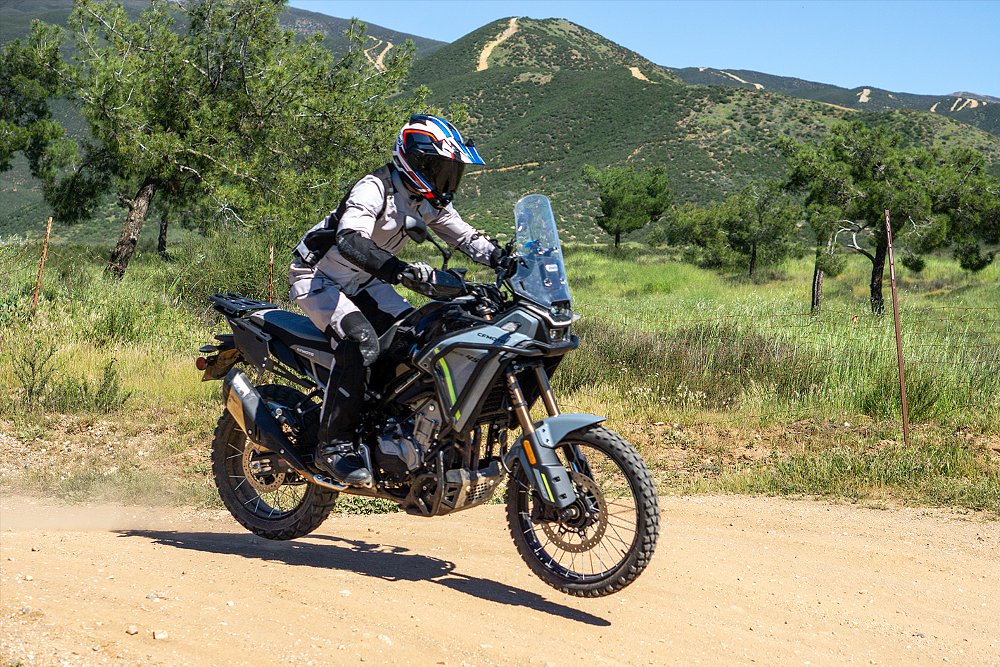
Finding that Zen when riding off-road typically leads to rowdier behavior. I was plowing through puddles. I was steering with the rear. I was launching the bike at every opportunity. Be it mud, or rock, traction was abundant. Feedback, response, control, you name it, the Battlaxs have it. Rolling on the AX41s, I was at one with the Ibex. The bike was simply an extension of me. It did exactly what I wanted it to do exactly when I wanted it to do it. I wasn’t just feeling confident. I was feeling empowered. Maybe too empowered, if the next incident is any indication.
I’m a creature of habit. That’s to say, I often tread the same trails when I take to the gravel. I know my limits, too. That’s the reason I always turn around when I reach a certain hill on my regular route. It’s not just rocky, it’s also steep and rutted. But with a set of AX41s under me, I was ready to take it on. Or at least I thought I was.
The first 30 meters went according to plan, with the Ibex flinging gravel in its wake. It was a very different story once my front wheel tracked into a rut — a rut crowded with rocks. Large ones, at that. Rolling to a stop did me no favors, either. Without momentum to roll over those rocks and out of that rut, I was heavy on the throttle and clutch. Only after powering out of the rut did I realize that hardly any power was transferring to the rear wheel. That’s when it dawned on me. I had burned out the clutch.
Thanks to a helpful hand from a KTM rider, I was able to push the Ibex a half mile up the trail. The thing is, I was still five miles from the main road. It’d be an uphill battle the whole way back, too. At that point, it was clear. It was time to start hiking. After trudging up the trail for two miles, a zebra-striped Tacoma rolled alongside.
“Hey, mate, you OK?” called the driver.
One hour later, and I was rolling the Ibex off the rear carrier of my new buddy (shout out to Derek). From there, a multi-hundred-dollar AAA tow finally delivered the bike back to my Los Angeles apartment.
The lessons learned? 1.) Know your limits. I’m sure a better rider could have surmounted that hill without a misstep. There’s a reason I hadn’t attempted it before. 2.) Carry tools. The Ibex doesn’t come with one under its seat. Plan accordingly. 3.) Remember the Ibex’s intended use. After all, it’s a heavier-than-average lightweight adventurer, not a 250-pound enduro. A word to the wise: Ride it as such.
| 2025 CFMOTO Ibex 450 | |
|---|---|
| Price | $8,985 (as tested); $6,499 (MSRP) |
| Engine | 449 cc, liquid-cooled, eight-valve, parallel twin |
|
Transmission, final drive |
Six-speed, chain |
| Claimed horsepower | 44 @ 8,500 rpm |
| Claimed torque | 32.5 foot-pounds @ 6,250 rpm |
| Frame | Tubular steel |
| Front suspension | KYB 41 mm inverted fork, adjustable for preload, compression and rebound damping; 7.9 inches of travel |
| Rear suspension | KYB shock, adjustable for preload, compression and rebound damping; 7.9 inches of travel |
| Front brake | Single J.Juan four-piston caliper, 320 mm disc with ABS |
| Rear brake | J.Juan single-piston caliper, 240 mm disc with switchable ABS |
| Wheelbase | 59.25 inches |
| Seat height | 34.25 inches |
| Fuel capacity | 4.6 gallons |
| Tires | Bridgestone Battlax AdventureCross AX41; 90/90R21 front, 150/70B18 rear |
| Measured weight | 458 pounds (accessorized) |
| Warranty | 24 months |
| More info | cfmoto.com |