Shop by Vehicle
 Track Order
 Contact Us

Motorcycles are beautiful in their simplicity. An engine, two wheels, a handlebar, and a place to sit. That’s all we really need.
Alright, fine, maybe brakes to slow down in case there’s a child in the road or something. And yes, OK, a headlight in case it gets dark, and a taillight so people know if I use those lame brakes you made me put on. But that’s it, dammit, that’s all I need. Then again, this seat isn’t very comfortable, so maybe a wider saddle of some kind. Pretty soon there’s fluid in your suspension and next thing you know a color TV in your cockpit. It spins out quickly.

The world of motorcycling has been pulling at the thread for more than 100 years now, and the machine that best encapsulates how stupendously complex motorbikes have become is arguably KTM’s 1390 Super Adventure S EVO. It doesn’t break new ground in any one direction so much as it scrapes together just about every slice of technology, large or small, into one machine.
Including an automatic transmission, which means of all the many features and options and doo-dads that are available, a clutch lever is not one of them. Instead, KTM Kustomers in these United States will get an Automated Manual Transmission — that is, an automatic clutch and a servo in the gearbox to do (most of) the shifting.
EVOlution or rEVOlution?
To take a step back, some of the 1390 Super Adventure S EVO is familiar. At the center of the bike is KTM’s 1,350 cc V-twin, largely the same engine that was updated to power the 1390 Super Duke R EVO. In this trim, that means variable intake valves, 173 claimed horsepower, and 37,000-mile service intervals. Also, 107 foot-pounds of torque which, in my experience, might actually be more torque than you can shake a stick at, at least if you’re trying to use it at the same time.

The overall shape, and intended purpose, of the new Super Adventure S is recognizable — in other words, big and brawny. It carries 6.1 gallons of fuel, has a 33.3-inch seat, and weighs 547 pounds with a full tank. Structural updates include a handlebar that is 1.2 inches wider, footpegs that are 0.4 inches wider set (and 0.3 inches lower), and seats that switch positions more quickly. KTM calls it a “new generation” of the machine, due in part to the adoption of the new engine, but also because of all the new technology that is baked into the bike.
WP’s latest-’n'-greatest ADV suspension carries the Super Adventure S EVO down the road, with updated internals that place the electronically controlled damping circuits in the same leg and shave more than a pound of weight. Plus, obviously, semi-active damping, loads of modes, and even more adjustability. There’s the usual suite of lean-angle-sensitive rider aids like traction control and ABS, plus different throttle maps, wheelie control, and engine braking adjustment. Radar units in the front and rear offer blind-spot monitors, collision warnings, and adaptive cruise control.

An eight-inch, full-color display is arranged vertically in front of the rider as the command center. Built-in navigation software means turn-by-turn directions can be displayed without an app or an internet connection, as discussed in the 990 RC R and 990 Duke R reviews. Again, the screen itself is also adjustable in a few ways, like offering touch-screen tweaks for the layout of information and selecting certain menu items. There’s really no reasonable way to explore the true depth of options in the dash, but here’s a snapshot.
The radar system that informs the adaptive cruise system also does a couple of other tricks — Riding Distance Assist, for example, which is sort of the opposite of cruise control in that the rider controls the speed of the motorcycle until you get too close to a vehicle in front of you and then it won’t let you gain on the traffic any more. Whether you like that or not doesn’t matter; the point is that the bike’s dash allows that system to be turned on and off independently of other radar-informed features, meaning you can have distance assist, or adaptive cruise, or both, or neither.

Expand that mantra of luxury whiz-bangs and ultimate adjustability out to the usual batch of pre-set ride modes, a few custom modes, and then all of the other aids and assists and this-’n'-thats in the menu, and you’ll get the idea. Would you like your wheelies to be low, or high? Very low, or very high? Ah, medium? Excellent choice.
Lots of Super, some Adventure
Not having ridden a KTM Super Adventure in many years, climbing onboard the 1390 S EVO felt familiar and as expected. Tall and broad, with a prominent fuel tank betwixt my legs and an angular windshield in front of my chest. I can’t say I noticed the slightly wider handlebar or lower footpegs, but it felt appropriate and comfortable.

Same goes for the muted thunder of KTM’s flagship V-twin, heavily muffled but also uniquely high-energy and quick to rev. Dropping this 1390 into gear is a little different than usual (more on that in a minute) but once I was underway what I found was the typical, clinical, KTM experience of a sport-focused ADV with a shot of nitrous.
Navigating city traffic is easy enough, as long as a 540-pound package with a 33-inch seat doesn’t feel too big, which it might. Interstate travel is pleasant by way of the chassis, and holding any speed under 100 mph is hilariously easy for the engine. Arguably the best part of a freeway is the on-ramp, where you can experience the monstrous powerplant in all of its glory, at least briefly.
In the case of a long, multi-lane slog I was happy to have the radar-assisted options. Adaptive cruise suited me better on crowded, two-lane roads where I needed a reminder to be patient, but it works well just about anywhere. It even has a setting for group rides, where it will try to understand that you’re riding in a formation of riders and behave differently than if it sensed cars or trucks.

Make your way to empty, meandering back roads and the ride will only get better. The 1390 Super Adventure S EVO is agile and balanced, with terrific brakes and a riding position that’s all-day comfortable. If the roads aren’t empty, no worries. Roll the throttle open and Thor will rap the back of the bike with his hammer and you’ll be breaking the speed limit before your riding buddies can grab a downshift.
Yabbut how does the auto trans work?
It would be an elaborate and dazzling motorcycle even without an all-new automatic transmission, which adds another silo of stuff to digest. The AMT system is just about as easy to use as you would expect of an automatic transmission — put it in gear, twist the throttle, and don’t worry — but it still takes some reprogramming of your own brain. Again, it’s the number of options that can be overwhelming.

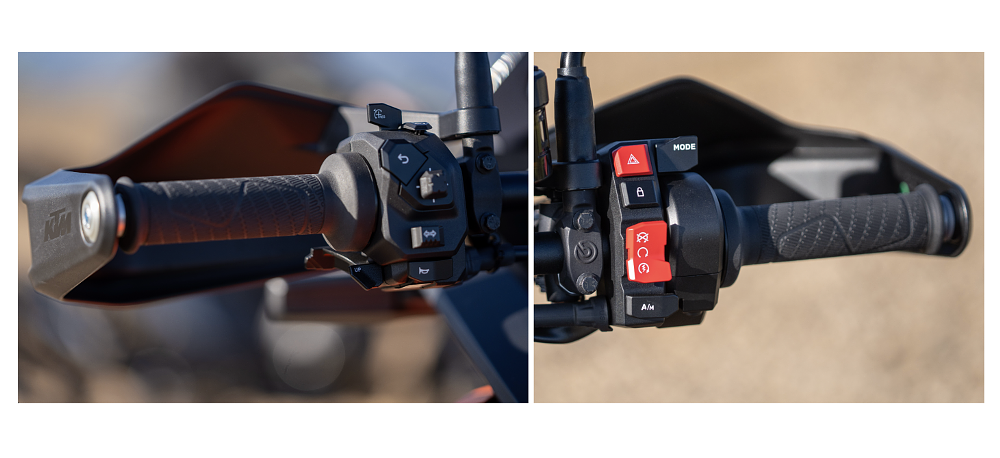
KTM chose to equip a set of triggers on the underside of the left hand grip, so that the rider can shift up with their thumb and down with their index-finger. But, there’s also a typical foot shifter which, instead of being connected to the gearbox via a linkage it simply triggers the same servo inside the transmission to spin the shift drum and change gears.
Rather than an electronically controlled automatic clutch, like Honda’s E-Clutch or DCT, KTM uses simple physics to engage the plates. A centrifugal, Rekluse-style clutch pack spins with the plates disengaged until the engine is revved to about 1,900 rpm, when integrated weights are forced outward and the plates ease toward each other. KTM claims that the whole AMT system is 2.2 pounds heavier and makes the engine 10 millimeters wider.

The gear pattern has been rearranged, too, with a parking gear “below” neutral and then all of the gears, sequentially, “above” neutral. You can think of it as P-N-1-2-3-4-5-6, which means that with the bike idling in neutral, pulling up on the shifter pops the bike into first gear. But, buckle up, this is where it gets weird. Probably because someone pointed out that going up to first is odd, you can also push down on the shifter and go to first gear. Then, once you’re moving, up to second, third, and so on.
Now, at this point you might think that if you press down with your foot while in first gear, the bike would go into neutral, and I agree that would make sense. But, no. Neutral and park can only be accessed by using the finger triggers, not the foot shifter. And if you’re not confused yet that’s good, because on the open road there are two additional (and switchable) ways to shift.

One is rev-limit shifting, which essentially means that the rider can turn on an option in manual shifting mode where the bike will upshift when it hits redline — some say chaotic, some say Ready To Race. The other is more interesting. The rider can roll the throttle forward, past fully closed, to trigger a downshift while decelerating. It’s an awkward skill to master while using the front brake to slow down, but simply drifting into a corner on a curvy road and grabbing a downshift with a quick forward flick of the wrist turned out to be pretty satisfying.
The wheat and the chaff
It’s hard to fault any of the electronic luxury items or systems, individually, for their performance. I did have a few lil’ notes, though. One is to say that the bike is not perfect, mostly because of the compromise it represents. The small amount of time I spent riding on dirt left me with the same sentiment as usual for a bike like this: It feels big and a little unwieldy on anything other than basic dirt roads. KTM, and everyone else, will quickly point out that there are a handful of other KTM models that are better suited to that, foremost the 1390 Super Adventure R.

Even on the pavement, the compromise is evident. The 1390 Super Adventure S EVO is commanding and comfortable on bumpy sections of road, or even hitting a speed bump, in part because it has 8.6 inches of suspension travel, front and rear. That’s plush. Swinging through a set of curves in a hurry, all of that extra travel can make it feel tall and the sheer weight of the thing will start to show.
My main complaints are to do with the AMT, and not because the automatic features don’t work well. It’s true that while in auto-mode it sometimes decided to shift when I wouldn’t have, and it can feel odd. And yes, you could argue that there are too many flippin’ ways to shift, especially compared to BMW’s system which is a little simpler. But, the options didn’t necessarily bug me.
One thing that did was downshifting while accelerating. The engine is so ridiculously strong that a downshift isn’t always necessary, but when I found myself wanting to pop down a gear while on the gas I found a clumsy combination of throttle-chop and gear change. It’s a tricky thing to map, and the machine could be hamstrung by the mechanical auto-clutch, but even some quickshifter-equipped machines in the past handled it better, and I think some programming could eventually fix it.

The other real rub in the riding experience is the dead-pedal feel of the foot shifter. KTM says that the servo can shift faster than a human foot and with less load on the transmission, which might be true but I have to say that I miss the feeling of my slow, inefficient foot moving actual metal. The shift throws are long, typical of a KTM, and in some ways that makes the experience of having no tactile feedback seem especially strange.
A whole new gamut of challenges exist in this world of automatic and semi-auto transmissions, and I won’t pretend to have all of the answers. That said, on a system like KTM’s AMT or BMW’s ASA, I think connecting the rider’s foot to a dummy linkage that at least feels kinda-sorta-like a transmission would go a long way toward making shifting enjoyable, and therefore preserving a little slice of what makes motorcycling great.

The only other criticism, broadly, that the new 1390 Super Adventure S EVO leaves itself open to is pure complexity. From how the rider shifts to the settings in the dash, it is pushing the envelope of excess. A really good synopsis of this bike is that when you first turn it on the huge, color screen suggests (I’m paraphrasing) that you should be careful because using a touchscreen while you ride a motorcycle could be dangerous. What an understatement.
Even with little wrinkles in the automatic shifting system and the potential entanglement in electronic options, or maybe in spite of those things, it is a stunning motorcycle. The sensation of letting this engine flex through a complete pull of rpm is a unique motorcycling experience. KTM engineers might puff out their chests and explain that the engine switches cam profiles at around 6,000 rpm and that’s why it feels so impressive. I’m not so sure.

I spent about 10,000 miles on a first-generation 1290 Super Duke R, with no Camshift technology and rudimentary, sometimes crummy, electronics. What a glorious motorbike it was. And I think if the 2027 KTM 1390 Super Adventure S EVO had no variable cams, no radar system, no finger triggers to shift, no electronic suspension, no linked ABS, no touchscreen dash, and no electronic features whatsoever it might be almost as awesome as it is with all of that stuff.
That’s the magic of this machine. A modern, tall-’rounder sport-touring rig that is comfortable to sit on and is powered by one of the best motorcycle engines ever made. All of the luxuries featured in the brochure make it nice. What makes it special is the basics.
| 2027 KTM 1390 Super Adventure S EVO | |
|---|---|
| Price (MSRP) | $22,699 ($23,598 as tested) |
| Engine | 1,350 cc, liquid-cooled, eight-valve, 75-degree V-Twin |
|
Transmission, final drive |
Six-speed, chain |
| Claimed horsepower | 173 @ 9,500 rpm |
| Claimed torque | 107 foot-pounds @ 8,000 rpm |
| Frame | Steel-tube trellis |
| Front suspension | WP 48 mm fork, adjustable for spring preload, electronically adjustable damping; 8.6 inches of travel |
| Rear suspension | WP shock, electronically adjustable for spring preload, compression and rebound damping; 8.6 inches of travel |
| Front brake | Brembo four-piston calipers, 320 mm discs with ABS |
| Rear brake | Brembo two-piston caliper, 267 mm disc with ABS |
| Rake, trail | 24.7 degrees, 4.3 inches |
| Wheelbase | 61.3 inches |
| Seat height | 33.3 / 34.1 inches |
| Fuel capacity | 6.1 gallons |
| Tires | Dunlop Trailmax Meridian; 120/70-ZR19 front, 170/60-ZR17 rear |
| Measured weight | 547 pounds |
| Available | Now |
| Warranty | Four years |
| More info | ktm.com |