
 Shop by Vehicle
 Track Order
 Contact Us
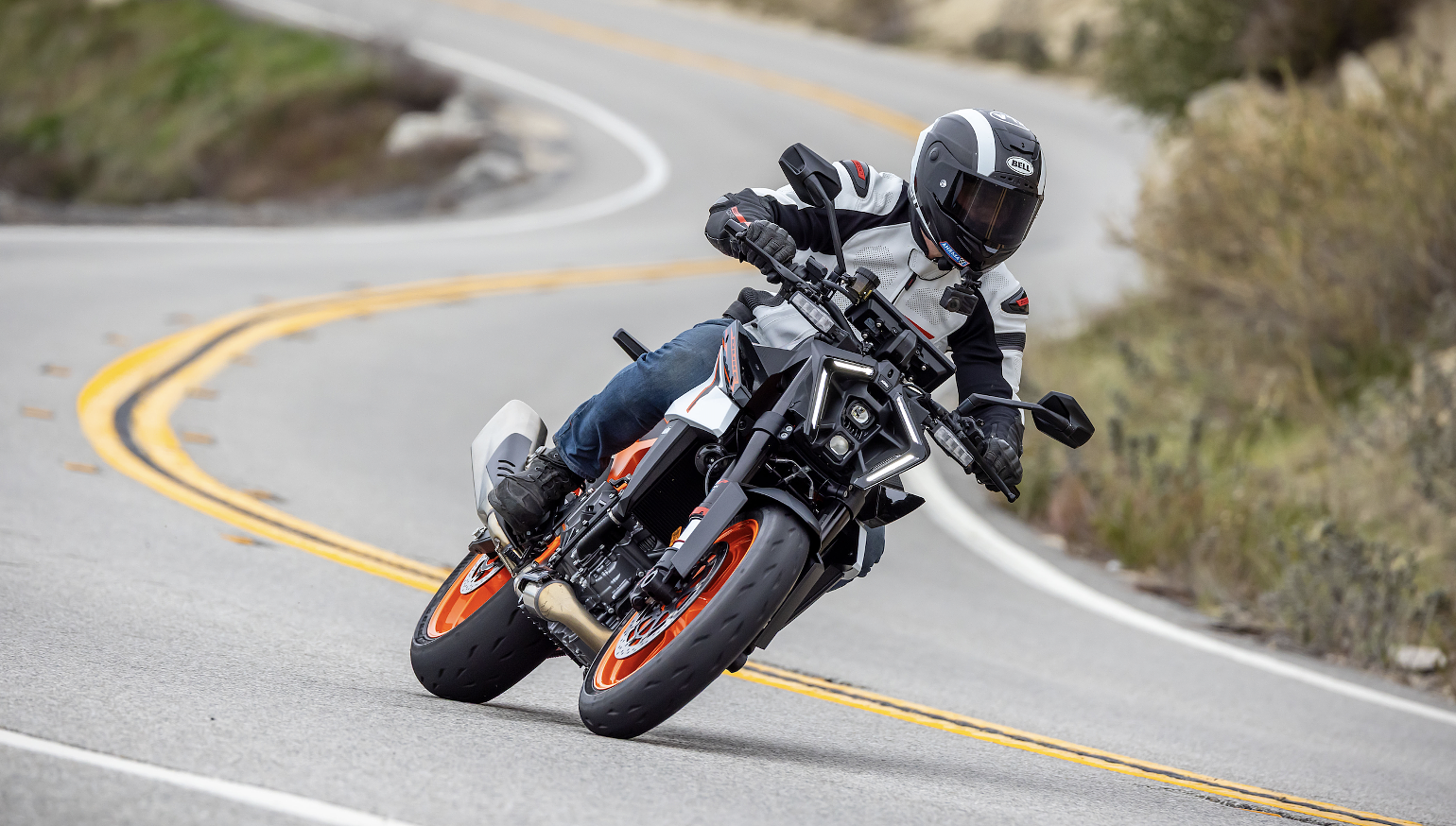
If you read Zack’s review of the KTM 990 RC R and, after wincing at his highside anecdote, thought the Austrians’ new sport bike seems appealing but might suit you better with less aggressive ergos and less plastic, you’re not alone.
That’s where my head was, too. I love sport bikes, but the version with a handlebar is almost always a better motorcycle for the real world. KTM must think so as well, because now there’s the 990 Duke R, which is essentially a stripped RC R with a ‘bar.
Naked and unafraid
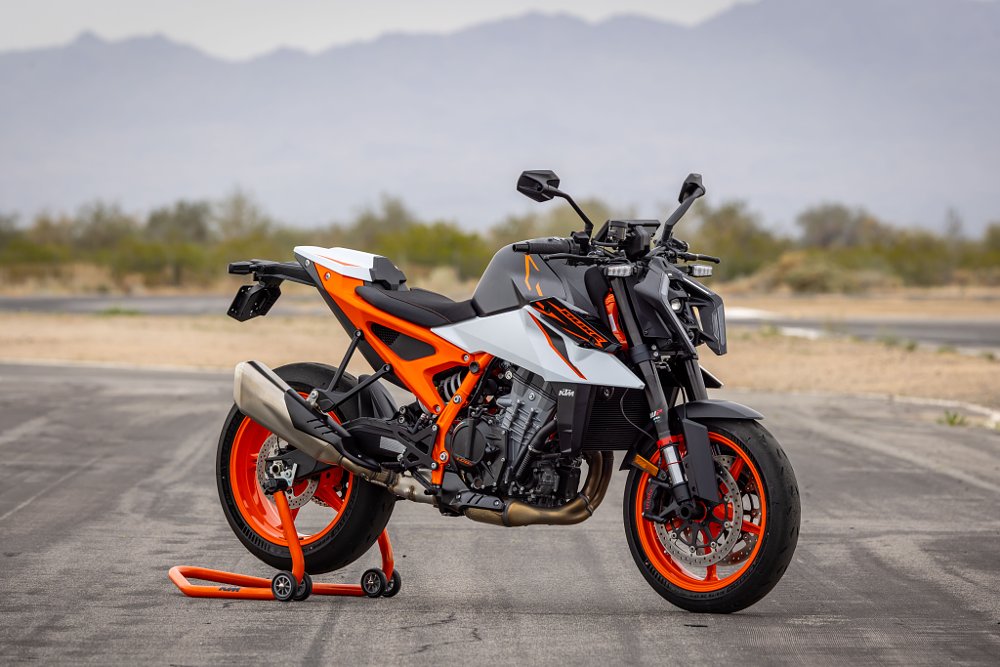
The new 990 Duke R is an up-rated version of the 990 Duke introduced in 2024. It rings in at $13,399, and its spec sheet ticks all the best boxes from the RC R’s. You get a full 128 claimed horsepower (up from 123 on the base Duke) and 76 pound-feet of torque from the 947 cc parallel twin. The same 8.9-inch touchscreen display graces the dash. There’s highly adjustable WP Apex suspension front and rear, including a bigger 48 mm fork (compared to 43 mm tubes on the base Duke). Braking equipment is also a rung up, with larger 320 mm rotors, burlier Brembo calipers, and a fully adjustable Brembo master cylinder.
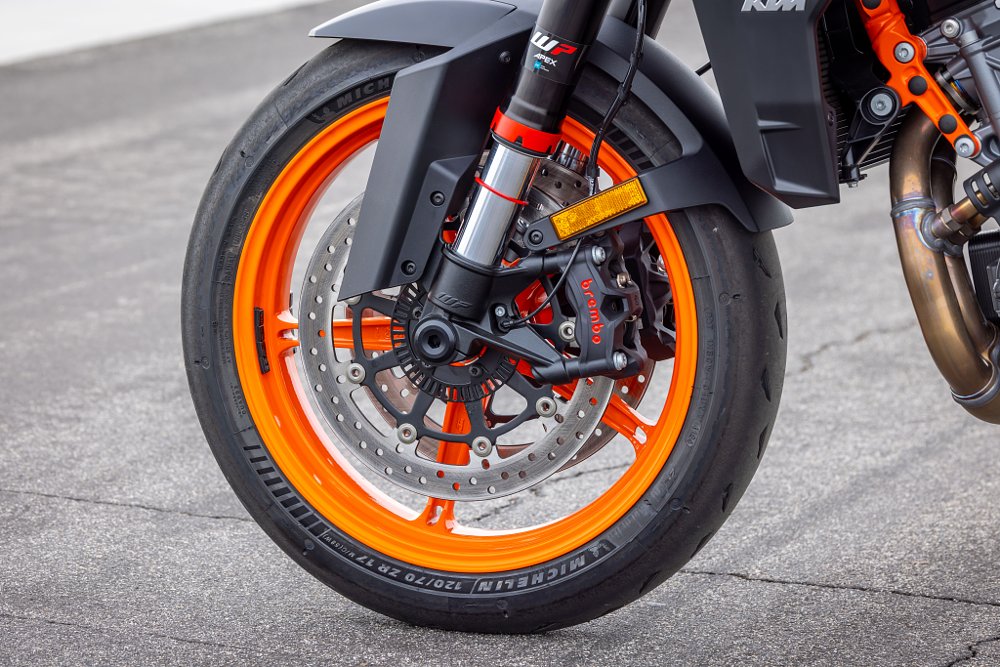
As with all of KTM’s R bikes, the changes are meant to enhance the Duke’s focus and performance, but thankfully this machine isn’t too committed. How could it be, with a handlebar atop that forged triple clamp? True, compared to the base Duke, the Duke R’s ‘bar is lower and farther forward (10 mm and 21 mm, or 0.4 and 0.8 inches, respectively) and its non-adjustable footpegs are up and back (12.5 mm and 33 mm, or 0.5 and 1.3 inches, ditto), but even so it’s still a fairly upright and comfortable riding position, especially compared to the RC R or any bike with clip-ons.
Street cred
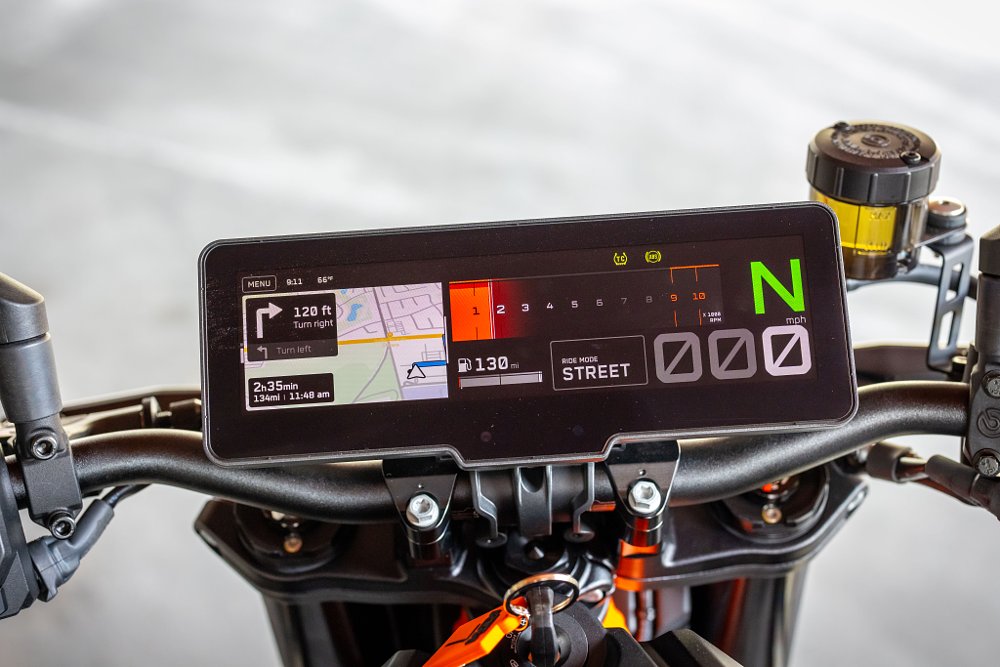
When I threw a leg over the Duke R at the bike’s press launch in Palm Springs, California, I was surprised by how compact it felt. At a claimed 418 pounds with 3.9 gallons in the tank, it is a remarkably light bike, but there’s more to it than what it feels like to lift off the sidestand. The handlebar is wide but the Duke is narrow between your knees — the well-padded yet firm seat pretty much sets the width for the flat tank sides and the footpeg brackets. Your forward view is sparse and uncluttered, and totally dominated by that panoramic dash, which is wide enough to obscure the butterfly adjusters on the tops of the fork tubes.
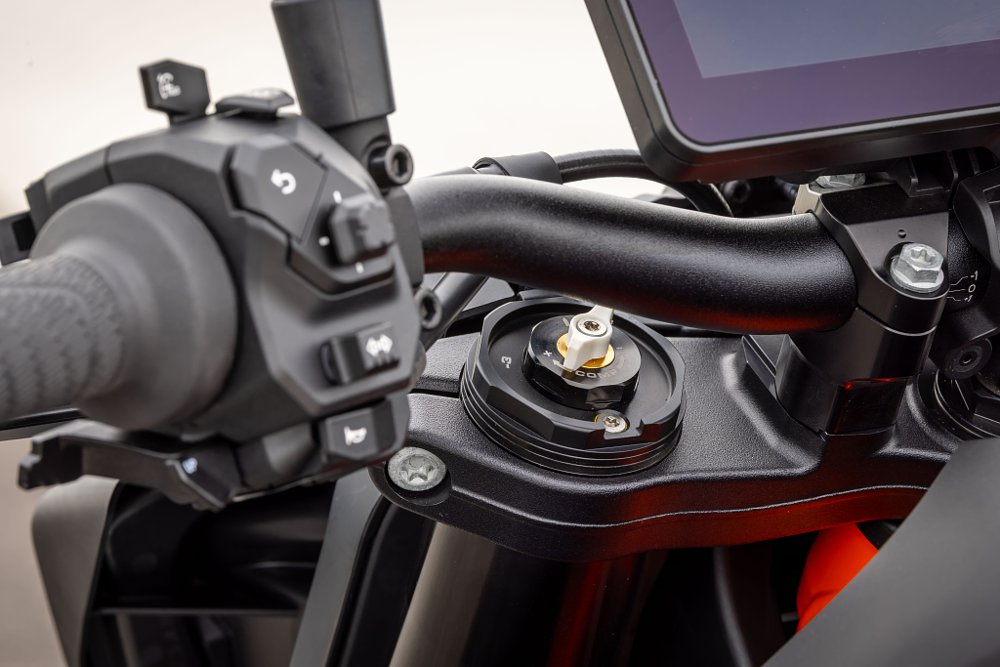
I typically roll my eyes at modern flamboyant displays and grimace at their convoluted menu systems, but KTM nailed the PX on this one. That massive screen provides room for excellent infographics that my monkey brain immediately understands, while the joystick on the left switch cluster or my gloved finger work to move through the various menus and adjust traction control, throttle response, and other features to my liking.
I especially (and surprisingly) appreciate the integrated navigation system that works without pairing to your phone. Type in a destination, select from saved favorites (like home or work), or just drop a pin at the top of that squiggly trace on the map and go. Bonus points for the fact that you can drag the nav screen over to take up more or less of the display; the rest of the data adapts to fit the space.
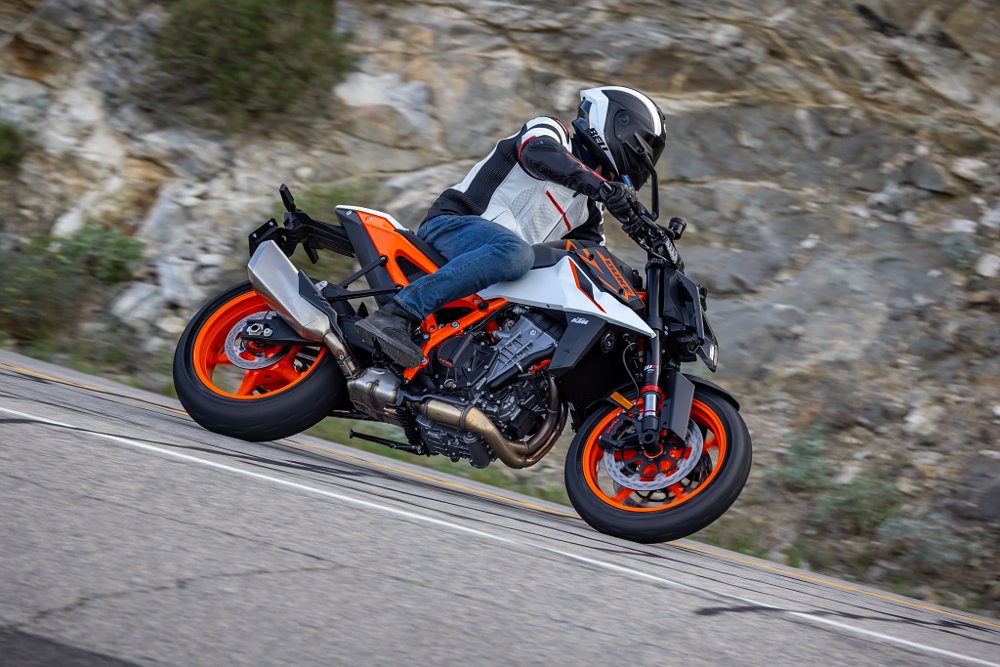
A Euro 5 exhaust subdues the big twin’s bark but doesn’t fully muzzle it, and boy is there a lot of power at the rider’s disposal. This motor lays the torque on thick. From the moment the clutch goes out you have immediate and abundant thrust that makes gear selection almost irrelevant on the street. Once our group of testers sliced and diced our way out of town and up into the mountains, I experienced a type of intuitive, effortless handling that only a few motorcycles I’ve ridden (in nearly 20 years of doing this) provide.
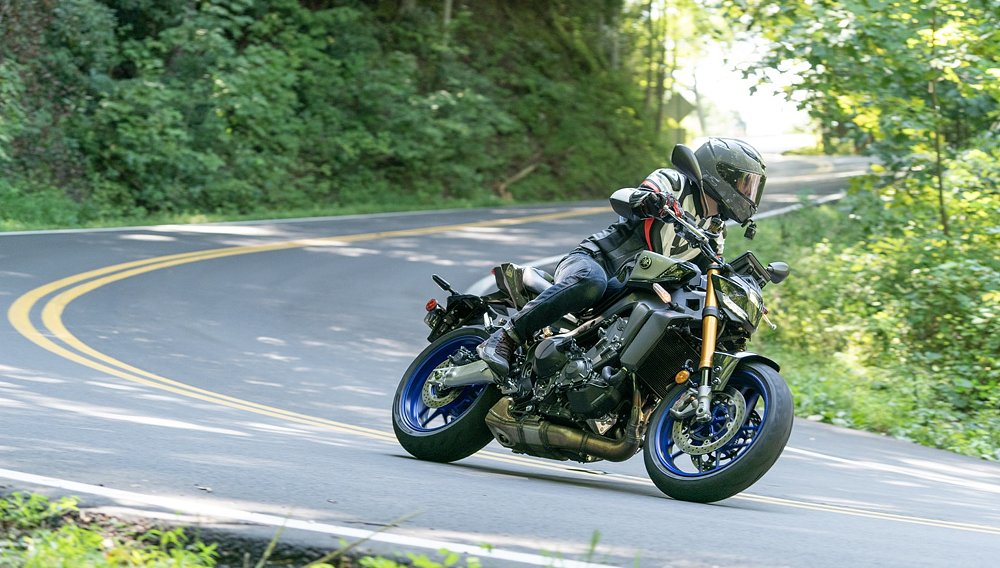
The Duke R combines immediate steering response and pinpoint accuracy with seemingly perfect stability. No body language (read: leaning off) is required to bend the bike down into a turn, and once leaned over it feels like you could take your hands off the ‘bar and the bike would stay on course. All the while, the suspension balances comfort and support, keeping the chassis rock-solid stable and transmitting everything the tires are dealing with without feeling harsh or stiff. It’s a canyon-carver’s dream, and I’d suggest aiming for the tightest roads you can find so you can fully appreciate the bike’s quick steering and stupendous torque.
To get to a twisty road, you may well need to hit the highway. We did a 20-mile stint and it wasn’t too bad. At five feet, eleven inches tall, I found that the riding position has just enough of a forward lean to offset the wind blast, and the engine feels relaxed and smooth while spinning 4,500 rpm at 75 mph in top gear. The footpegs and grips buzz a bit above 6,500 rpm, but at that point you’re well into triple-digit speeds.
Track antics
Speaking of speed, we spent the second day of the press launch at Chuckwalla Valley Raceway so we could experience this R bike in a less restrictive environment. KTM removed the mirrors and rear fender (with its turns signals, which also serve as the tail light and brake light), and replaced the Michelin Power Cup 2 tires with Dunlop Sportmax slicks, and then let us loose.
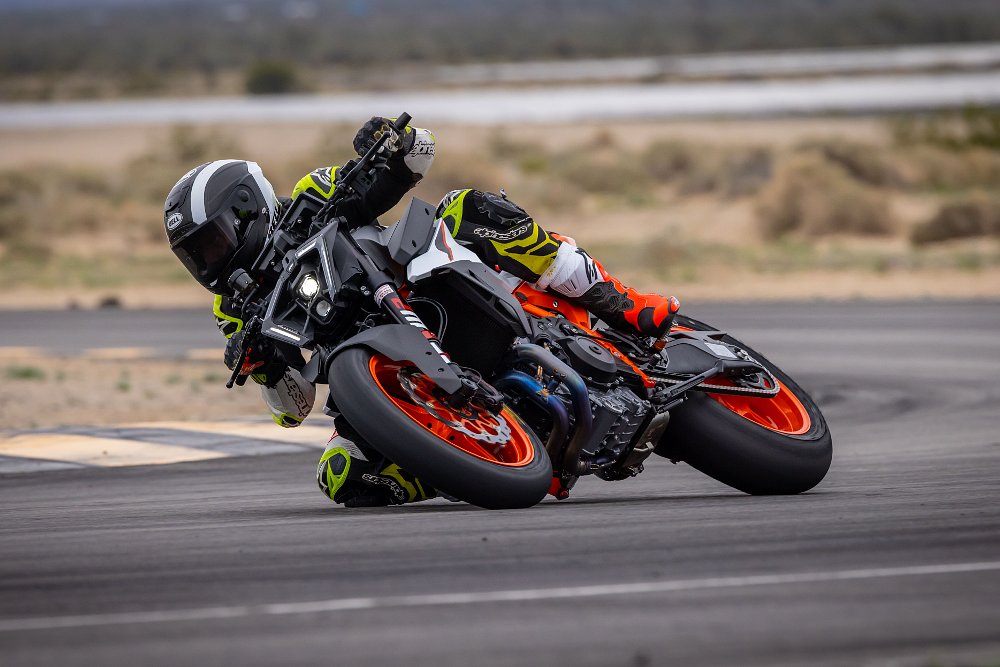
I’ve spent a lot of time at Chuckwalla, but not in recent years, so it was a real treat to be back. The Duke R was a fantastic dance partner. All the characteristics that I appreciated on the street scaled to the track, which isn’t always the case.
I expected the twin’s power to nose over in the upper revs, but it keeps pulling. Even so, you get much better drive short shifting, and I had to talk myself out of downshifting as much (or at all) entering corners so that I’d be in the meat of the torque coming off the apex.
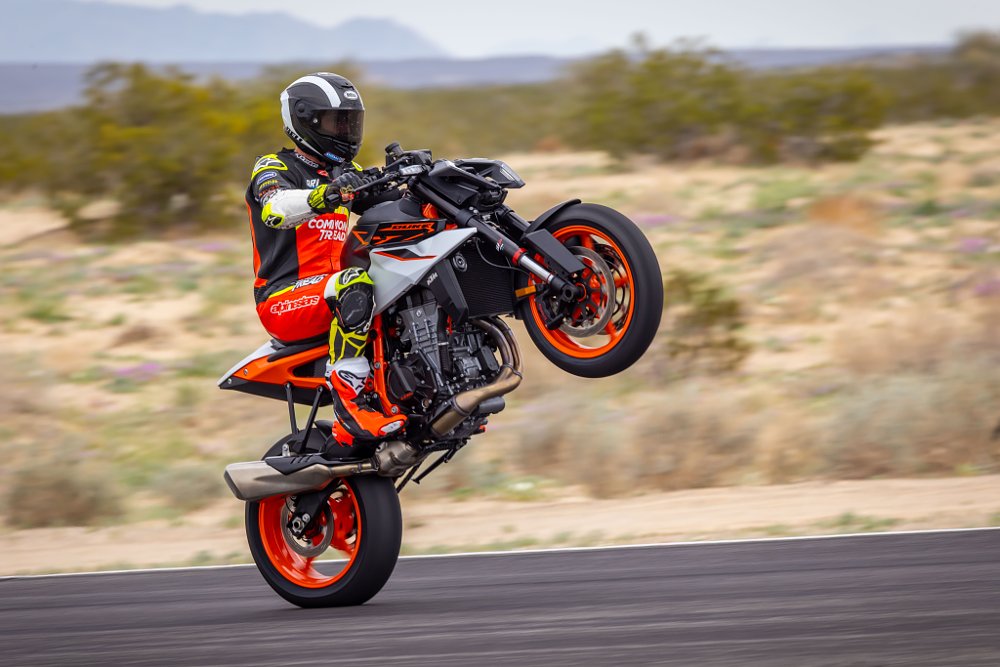
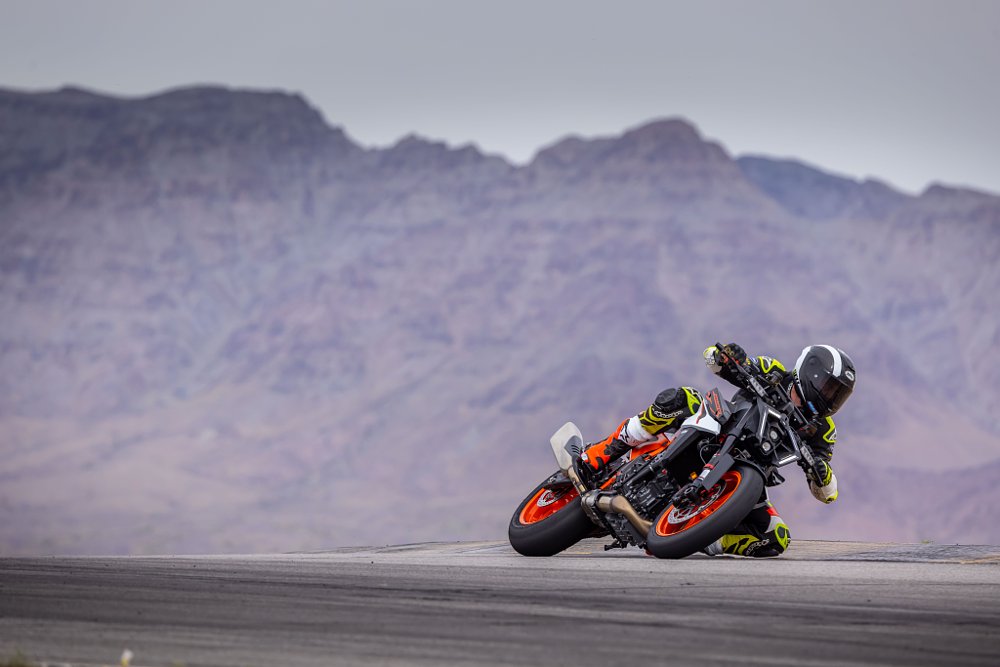
Once again, I was impressed with the bike’s stability at full lean. In fact, in the Turn 4 and 5 combo, which are treated as a nearly continuous 190-degree arc, I found myself adding throttle very early while fully leaned over entering Turn 5. And not just a little maintenance throttle, I’m talking about steady rotation of the right grip that set the rear tire squirming. Even with that much acceleration added to the equation, the bike zeroed in on the second apex. Some riders said the bike wasn’t tracking as well for them, but a few suspension adjustments dialed in the handling.
In the clockwise direction Chuckwalla doesn’t have any truly hard braking zones, but there’s loads of trail braking, and I spent a lot of time pulling the lever until well after my knee touched the deck. Braking power and feel are excellent, and the chassis is perfectly content to accommodate braking and turning at the same time.
Full chat at 120 mph on the back straight or navigating the rapid right-left-right of “Crash Mountain,” the Duke had me grinning all day. And that’s the thing — I rode every lap of every session all day, and my back and knees never asked for mercy. All hail the handlebar.
An inevitable comparison
This is a bike I’d relish riding to work (I love sneaky low-power wheelies leaving stop lights) and in the canyons on the weekend, and it’s more than capable of scratching my track-day itch. However, there’s another bike I’ve ridden that can do those things.
Triumph’s up-spec Street Triple RS follows a similar formula to the Duke R, with similar results. Up until now, it's been the benchmark in the performance-naked category. However, that bike is a bit heavier (414 pounds), slightly more expensive ($13,845), and, at least on stock suspension settings, marginally stiffer and less comfortable on the street. The engine also has a different character, with more emphasis on the upper rev range, and the dash is nowhere near as appealing. Quite the opposite. For my money, I'd get the Duke R.
If you can compartmentalize everything KTM is going through right now and assess the bike for what it is, the 990 Duke R is a home run. I expect the full-faired RC R will likely sell better here in the US, but for those that think life is better with a handlebar, you’re not alone, and you’re not wrong.
| 2026 KTM 990 Duke R | |
|---|---|
| Price (MSRP) | $13,399 |
| Engine | 947cc, liquid-cooled, eight-valve, parallel twin |
|
Transmission, final drive |
Six-speed, chain |
| Claimed horsepower | 128 @ 9,500 rpm |
| Claimed torque | 76 foot-pounds @ 6,750 rpm |
| Frame | Steel tube, engine as a stressed member |
| Front suspension | WP APEX 48 mm fork adjustable for spring preload, compression and rebound damping; 5.6 inches of travel |
| Rear suspension | WP APEX shock adjustable for spring preload, compression and rebound damping; 5.5 inches of travel |
| Front brake | Brembo four-piston calipers, 320 mm discs with ABS |
| Rear brake | Brembo two-piston caliper, 240 mm disc with ABS |
| Rake, trail | 24.2 degrees, 3.9 inches |
| Wheelbase | 58.3 inches |
| Seat height | 33.0 inches |
| Fuel capacity | 3.9 gallons |
| Tires | Michelin Power Cup 2; 120/70ZR17 front, 180/55ZR17 rear |
| Claimed weight | 418 pounds wet |
| Available | Now |
| Warranty | 24 months |
| More info | ktm.com |
Image Gallery
Image Gallery

Shop the gear
 Bell Race Star Flex DLX Helmet$949.95
 SEDICI Corsa 2 Jacket$279.99
 Alpinestars Tech-Air 5 Plasma Airbag System$869.95
 REAX Castor 2 Perforated Gloves$99.99
 Klim K Forty 2 Jeans$279.99
 REAX Fulton Air CE Riding Shoes$159.99
 Alpinestars Supertech R Boots$649.95
 Alpinestars GP Tech v2 Gloves$434.95
 Alpinestars Racing Absolute v2 Race Suit$4,569.95