Shop by Vehicle
 Track Order
 Contact Us
“A lot of the things that have transpired through the years have been good for safety benefits, absolutely. But in some ways it kind of numbed the experience.”
That’s how three-time Grand Prix motorcycle champion Freddie Spencer introduced the 2026 Honda CB1000F.
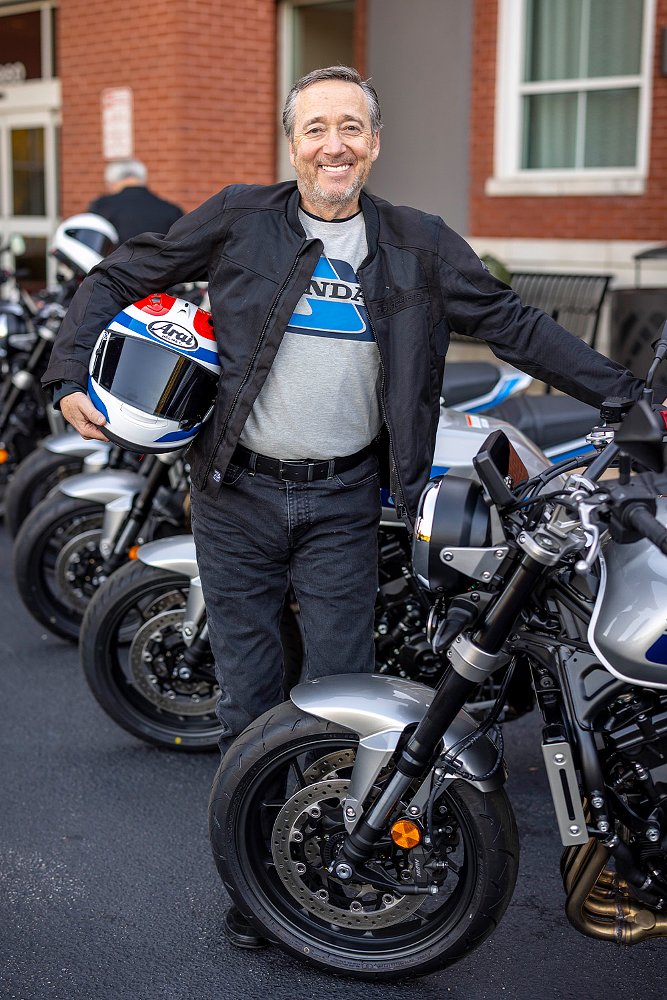
It was no surprise to find “Fast Freddie" at American Honda’s press launch in Hoover, Alabama. After all, the two bikes that steered the CB1000F’s throwback styling — the CB750F and CB900F — are synonymous with the legendary racer.
That association is a byproduct of Spencer’s winning ways aboard the two CBs, both in the AMA Superbike Championship and on the banked walls of Daytona. It doesn’t mean they were perfect machines. Far from it, actually. According to Señor Spencer, the CB900F, with its “‘70s-technology chassis” and “about 125 horsepower,” was “really interesting to ride, but it had a personality, it had a characteristic.” Big Red attempts to recapture that quality, to un-numb the experience, with the CB1000F.
Under the influence
In basic terms, Honda’s retro roadster is built upon the base CB1000 Hornet sold in Europe, not the SP variant available here in the States. However, the Hornet simply serves as a starting point. A regimen of revisions, both aesthetic and mechanical, imbues the F-spec CB with a spirit of its own.
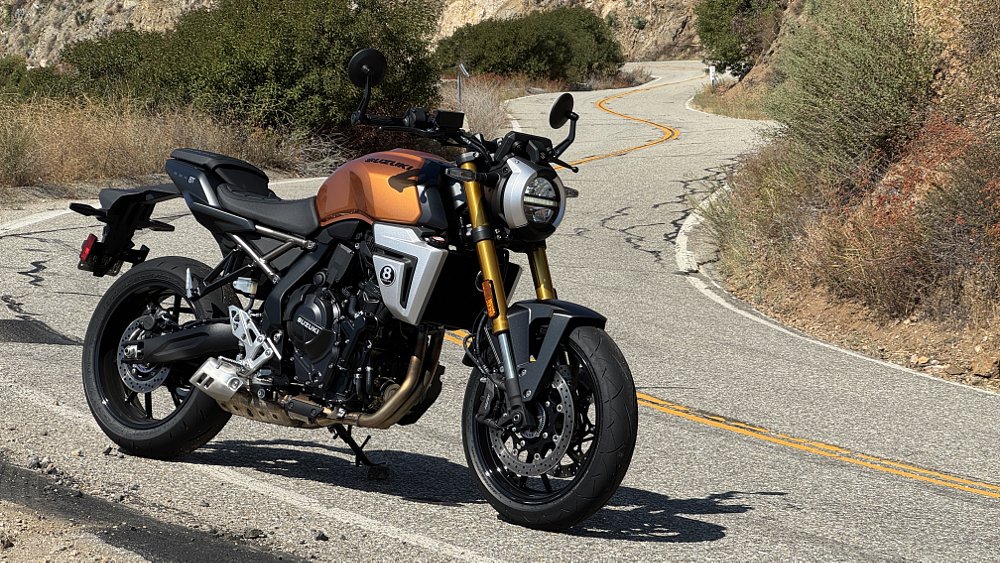
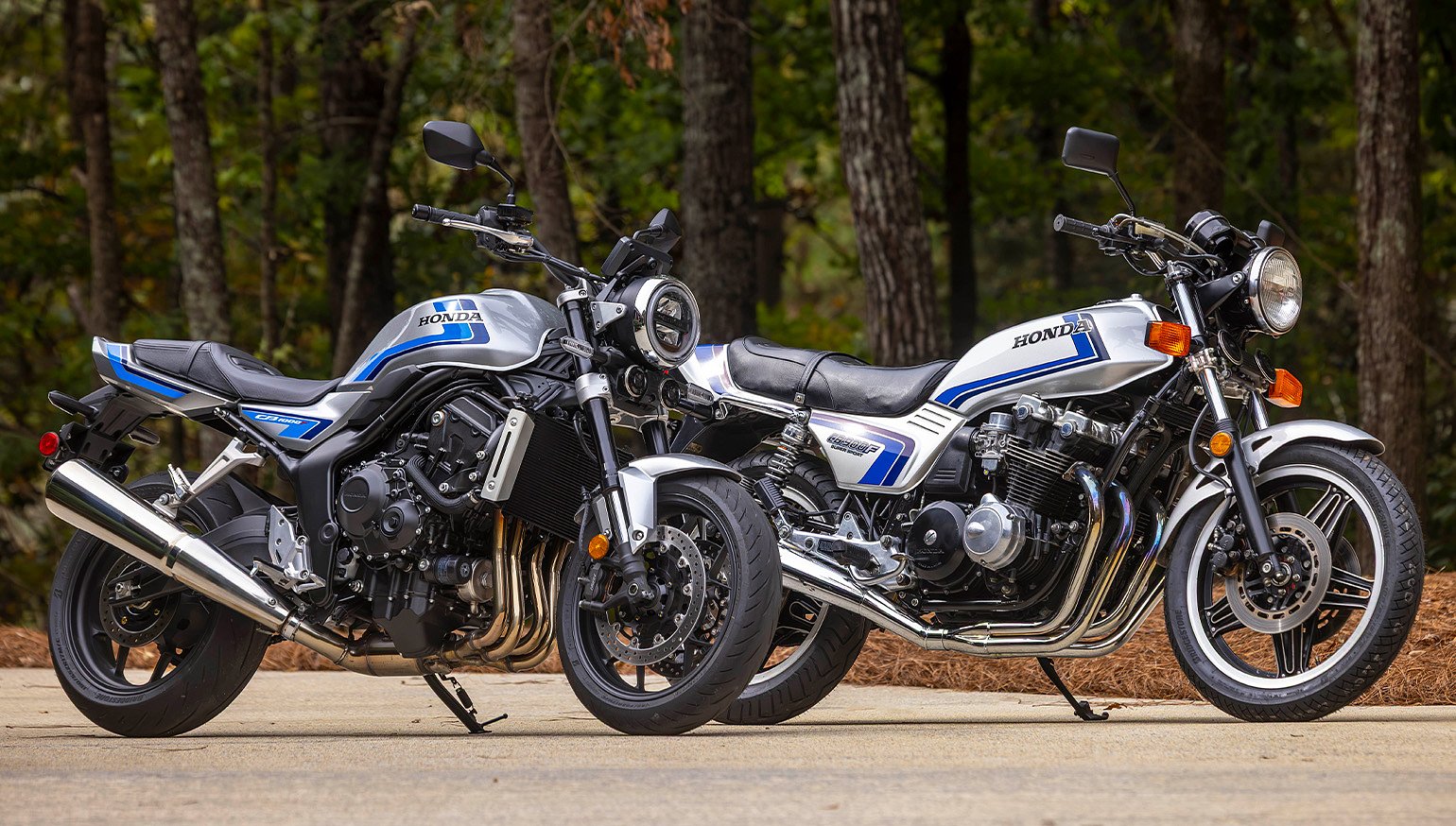
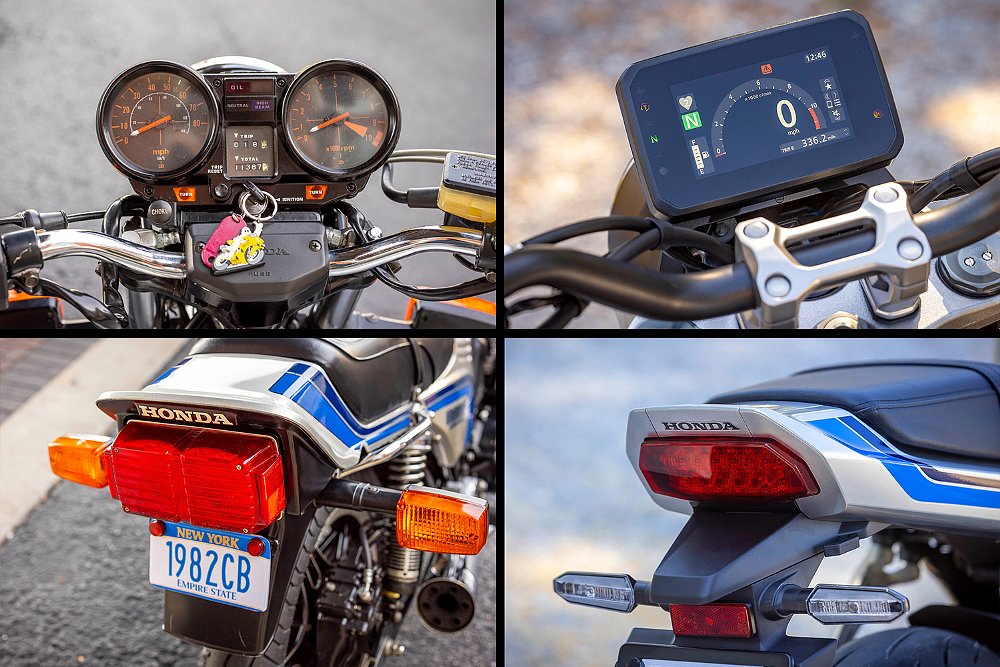
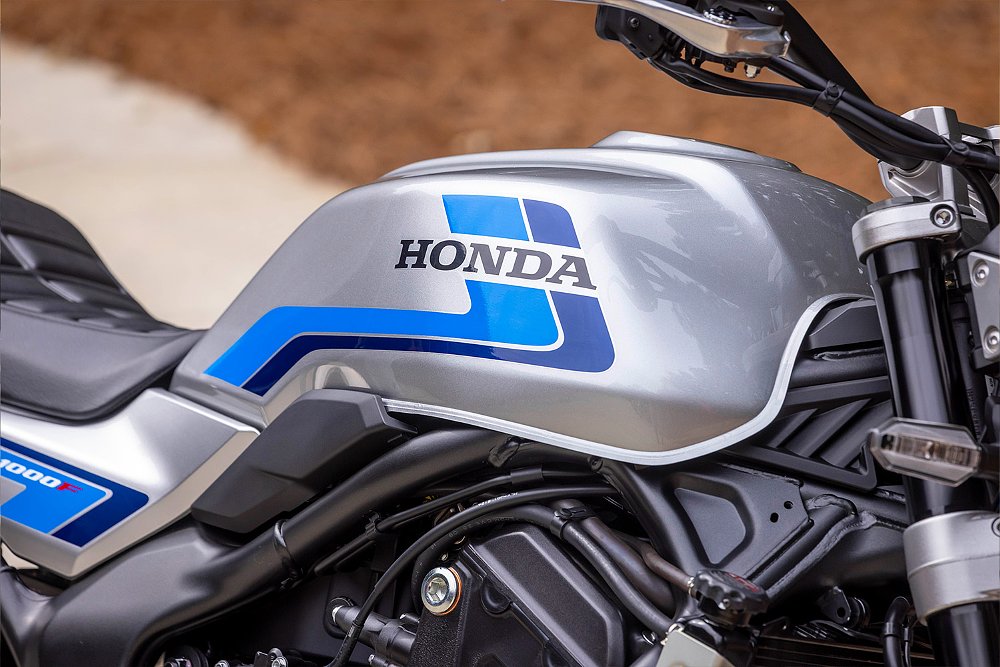
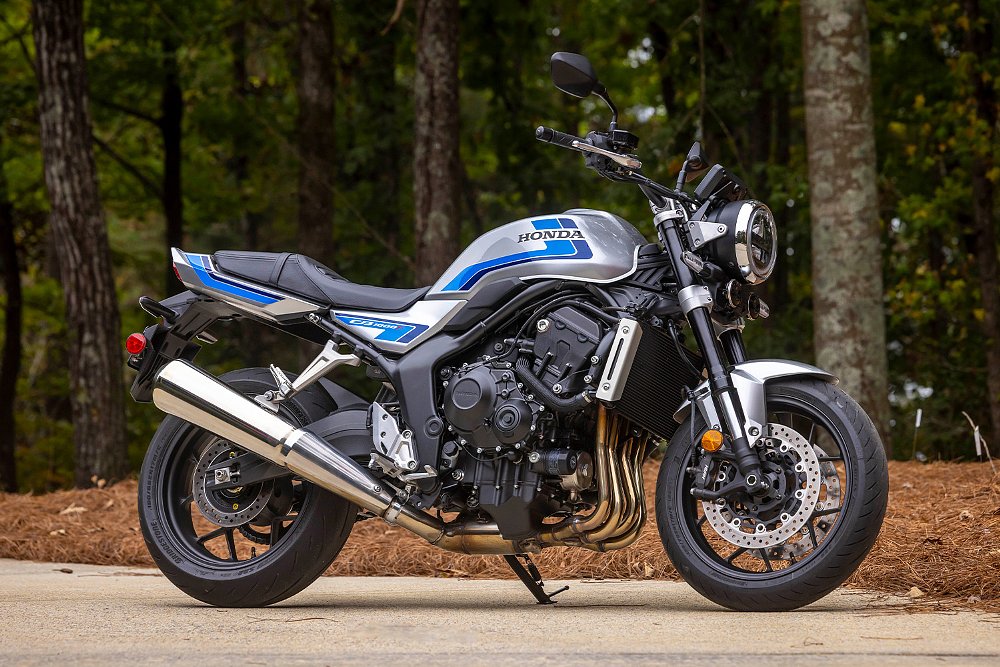
The stylistic changes are extensive, going well beyond retro bodywork and a badge swap. The Wolf Silver Metallic livery and round LED headlight may draw the eye first, but that’s just two of the visual Easter eggs calling back to the CB750F/CB900F.
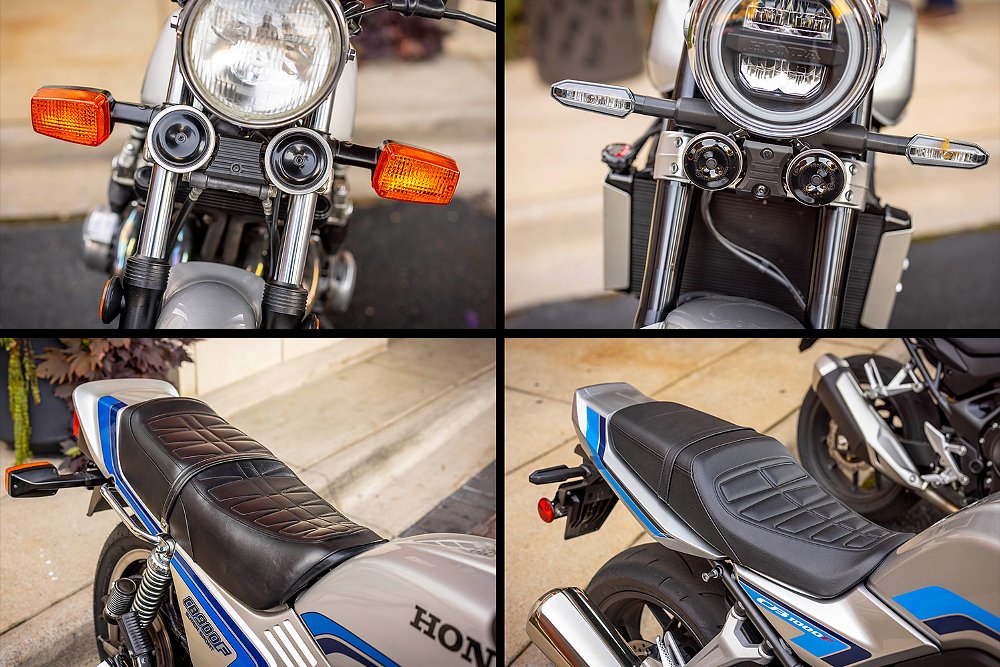
The fork-mounted double horns mimic those found on the originals. There’s a pleated black leather seat and a rectangular brake light tucked under the tail. Even the exhaust silencer adopts a traditional megaphone shape. Mated to that muffler via four chrome-finished headers is an engine that Honda reportedly tuned “for a distinctive sound, feel, and classic CB character.”
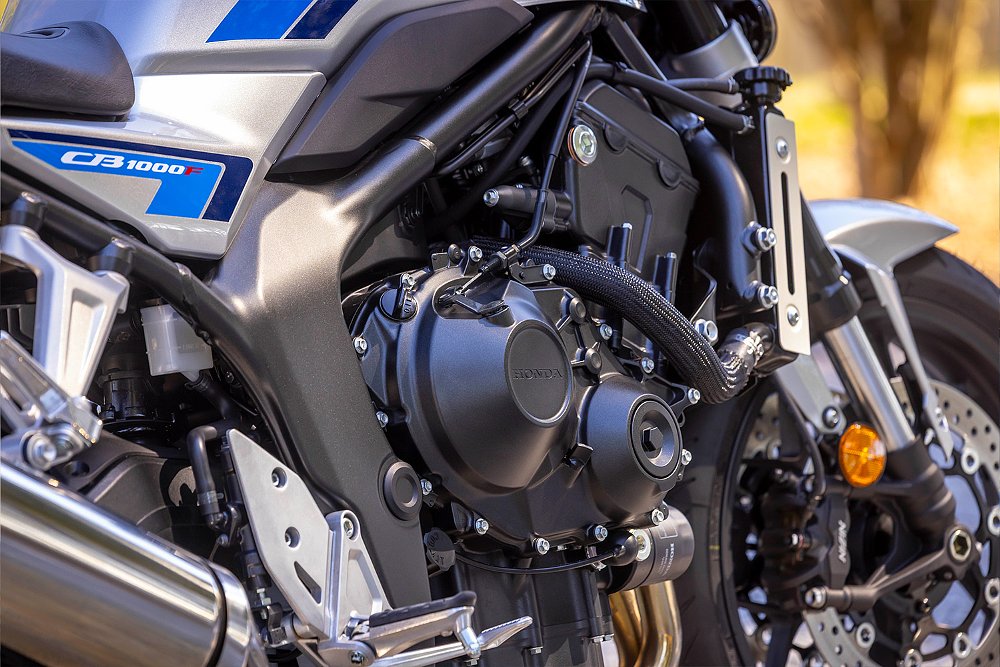
Lifted from the CB1000 Hornet, the liquid-cooled 1,000 cc inline four maintains its 76 mm bore, 55.1 mm stroke, and 11.7:1 compression ratio. But the similarities end there. A new camshaft not only adjusts intake and exhaust timing, but also intake and exhaust lift. What’s more, Honda engineers offset the valve timing between the first two cylinders and the last two cylinders, contributing to the F’s pulsating sound and feel.
The model’s varied inlet diameters (cylinders one and two: 40 mm; cylinders three and four: 50 mm) only accentuate that trait further. To enhance engine response under 6,000 rpm, Big Red lengthened the intake funnels by 50 mm and swapped out the Hornet’s 15-tooth front sprocket for a 16-tooth unit.
That’s the long story. The short of it is: The CB1000F isn’t a Hornet with a facelift. It isn’t cosplaying as a classic bike. It’s engineered to remind us of one, too. That’s easy to deduce from the spec sheet alone. Experiencing it, however, requires time in the 1000F’s saddle.
Cool, calm, and collected
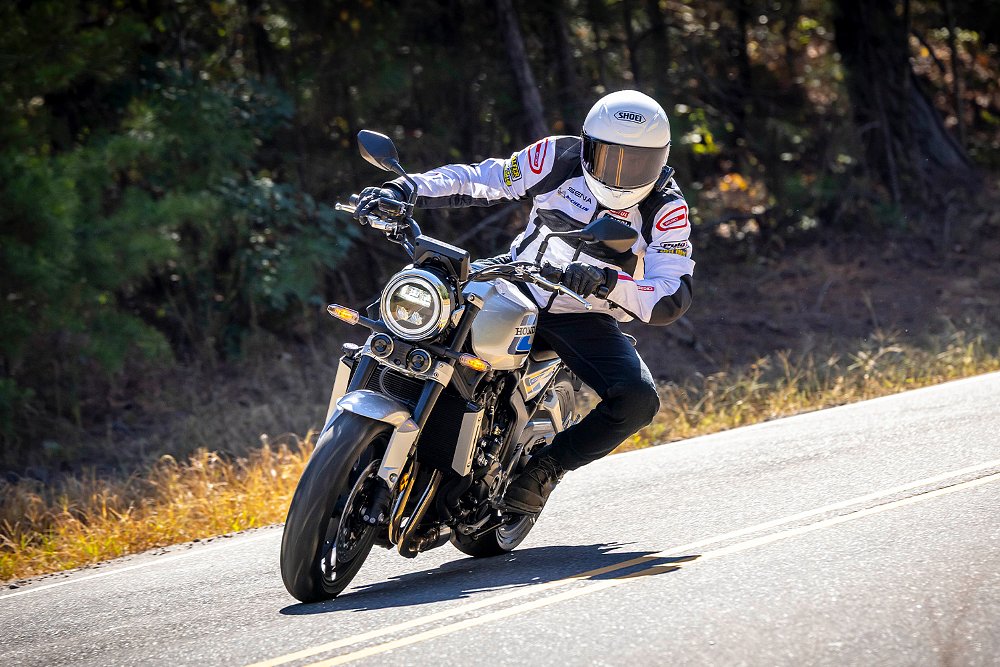
If the Hornet SP is the sharp-edged athlete of the CB family, the CB1000F assumes a more casual attitude. Its handlebar is 1.2 inches taller than the SP’s, which eased my reach to the grips and lifted my upper half into a neutral, nearly upright position. The legroom was just as accommodating, thanks to lower footpegs lifted from the Euro-exclusive CB1000GT model. Pegs that relaxed my knees into a 90-degree angle.
The only component that gave me pause was the low-profile seat. Its benefits are both visual and practical, as the CB1000F’s seat height rests at 31.3 inches, or 0.6 inches lower than the Hornet’s. That trimmer form allowed me to flat-foot the bike at every stop, with inseam to spare. To my surprise, the saddle wasn’t short on comfort, either.
If you’re planning an interstate road trip, a thicker-padded aftermarket replacement might be in your best interest, but the stock seat was more than sufficient for the 180-mile backroad route our group covered. Let’s put it this way: The only discomfort I experienced occurred during the last 30 minutes of a seven-hour day. Given the CB’s intended use, balancing that comfort with capability is essential. Its updated suspension only supports that objective.
I didn’t have the privilege of riding the Hornet SP, but judging by Lance’s assessment, the model’s stiff rear shock left a lot to be desired but offered enough adjustability to allow a rider to address that. Fortunately for me (and my spine), Big Red took a different approach to the CB1000F. A new shock linkage and dedicated suspension settings prep the roadster for life in the city and in the canyons, with bump-smoothing action through the initial stroke and firmer response in the mid-stroke.
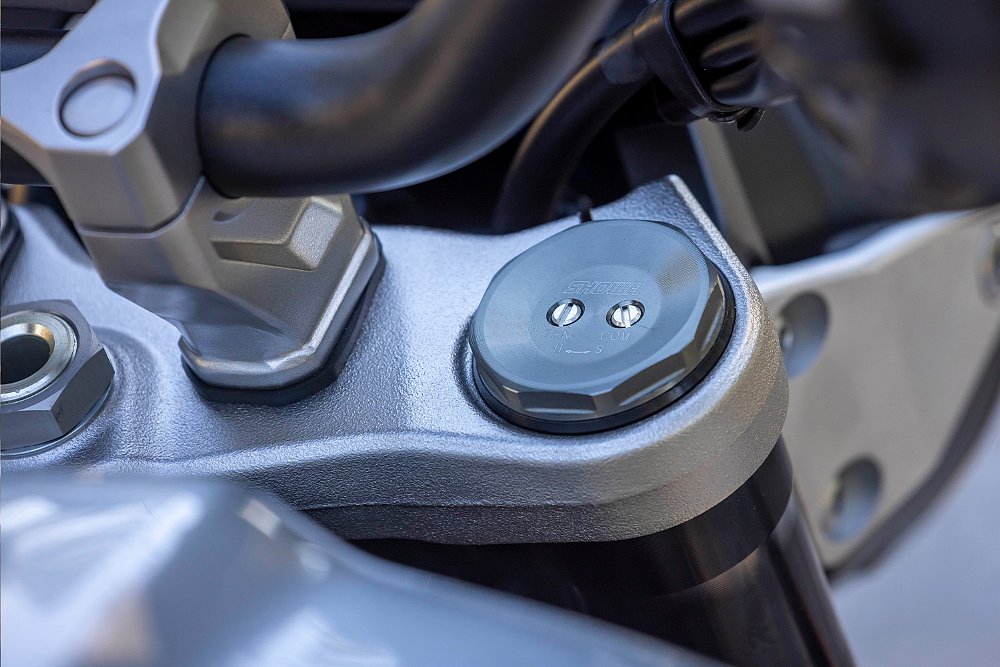
Several sections of road through the industrial town of Bessemer were overdue for resurfacing, from crumbling pavement to deep potholes to abrupt bumps. Still, the CB softened all but the worst road inconsistencies, yielding a forgiving ride. Impact absorption isn’t its only trick, either. That’s because the 1000F also delivered when the speeds picked up and the turns tightened.
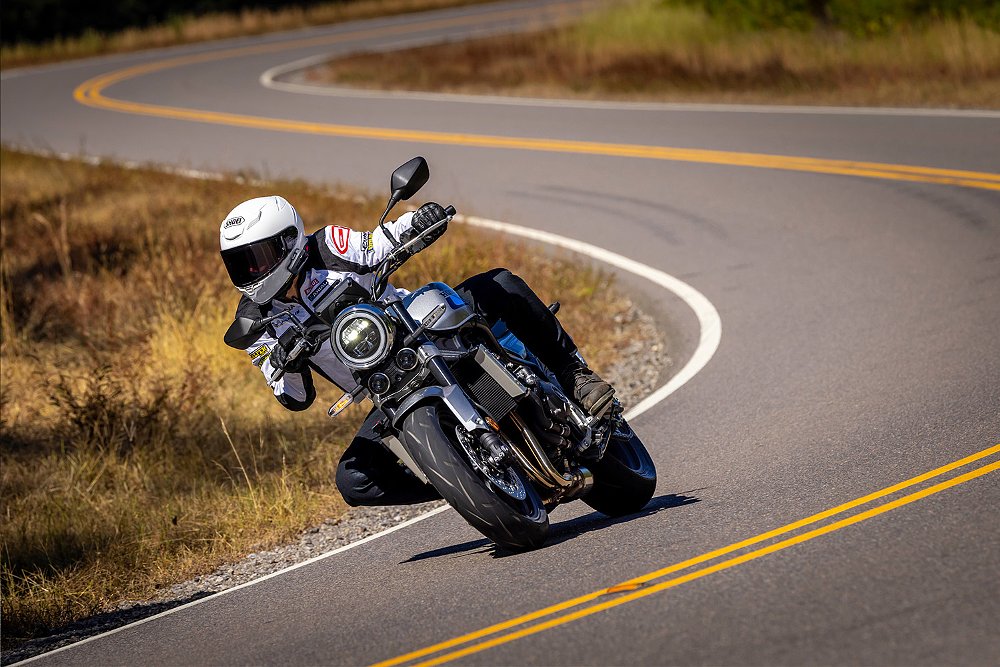
The retro-styled naked bike may tip Honda’s scales at 472 pounds, but it tips into corners with alacrity. It owes some of that turn-in agility to its tall, wide handlebar, which provides additional leverage when pulling the CB into a bend. No other liter-sized bike, at least among those that I’ve ridden, is as easy to throw around. It’s stable through fast kinks. It’s nimble around second-gear hairpins. It even changes directions both smoothly and instantly. It isn’t faultless, though.
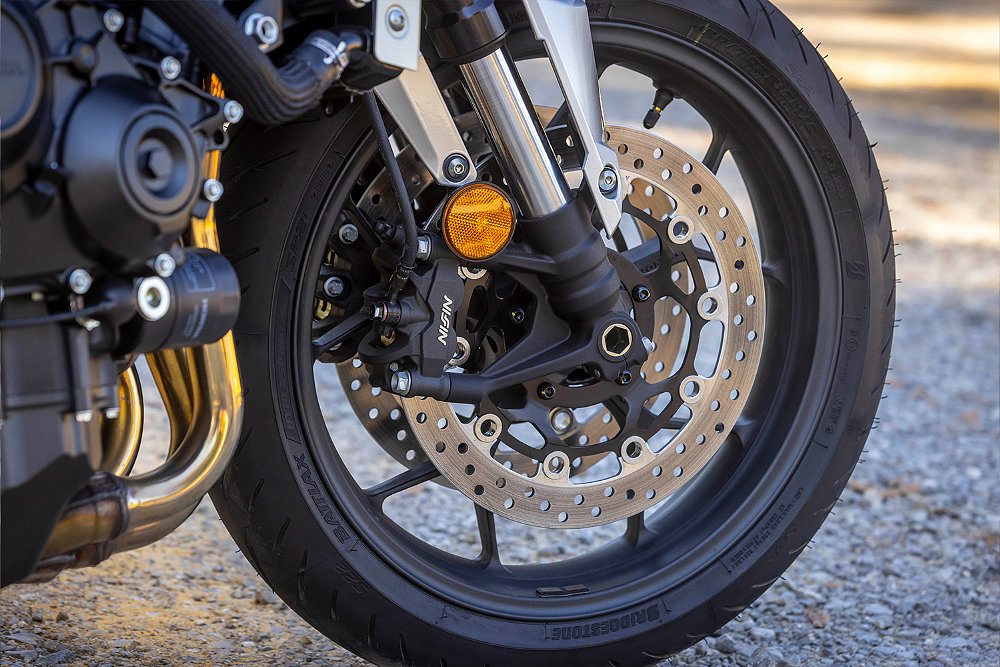
Pushing the pace also pushed the 1000F to its limits. On several occasions, I missed apexes or ran wide of my line. I wasn’t the only one either. Other members of our group overcooked corners as well. I suspect the rubber-hose-fed calipers and re-tuned suspension contributed to those moments, but it’s worth noting that this CB forfeits some of the precision of its Hornet sibling in the name of comfort and convenience. The same could be said for the model’s powerplant.
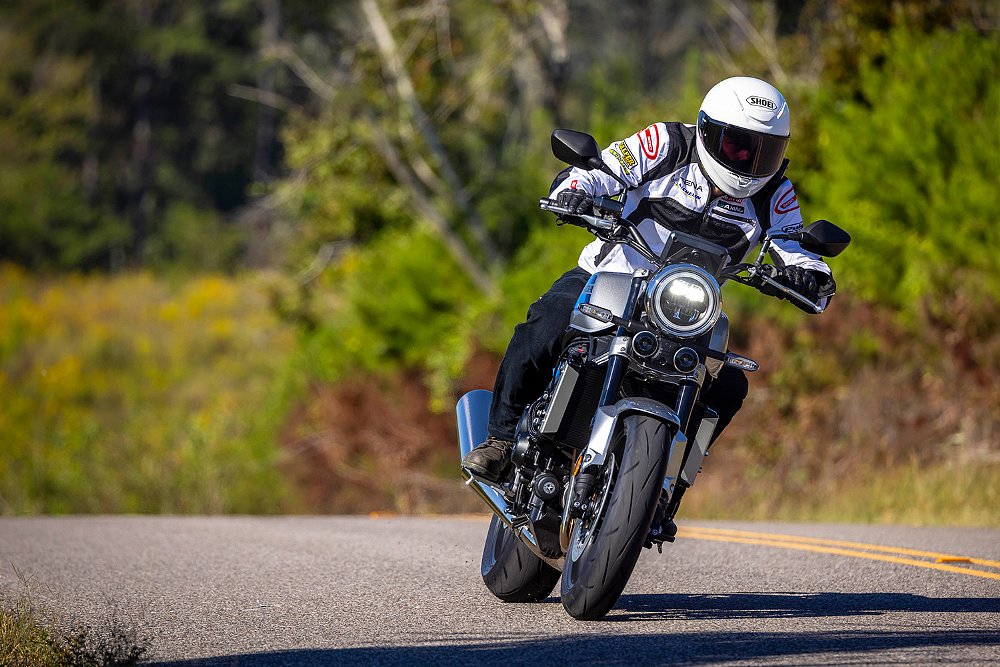
Sometimes, no, most times, it’s better to feel fast than to be fast. (That’s especially true if you’re trying to hold on to your driver’s license.) The CB1000F does just that. Not only is its inline four re-tuned for a rawer, more visceral experience, but its shorter first two gears only amplify the sensation of acceleration. The key word here is “sensation,” because the speedometer often displayed a lower number than I anticipated.
That, by no means, is a bad thing. Indulging my appetite for speed, all without ticket-baiting behavior, is always a win in my book. It doesn’t come without a cost, however. That’s because the vintage-clad CB runs out of steam in the upper register. In essence, it trades a rev-happy top end for a torque-heavy bottom end and a responsive mid-range. For this rider, at least, it's a worthy compromise.
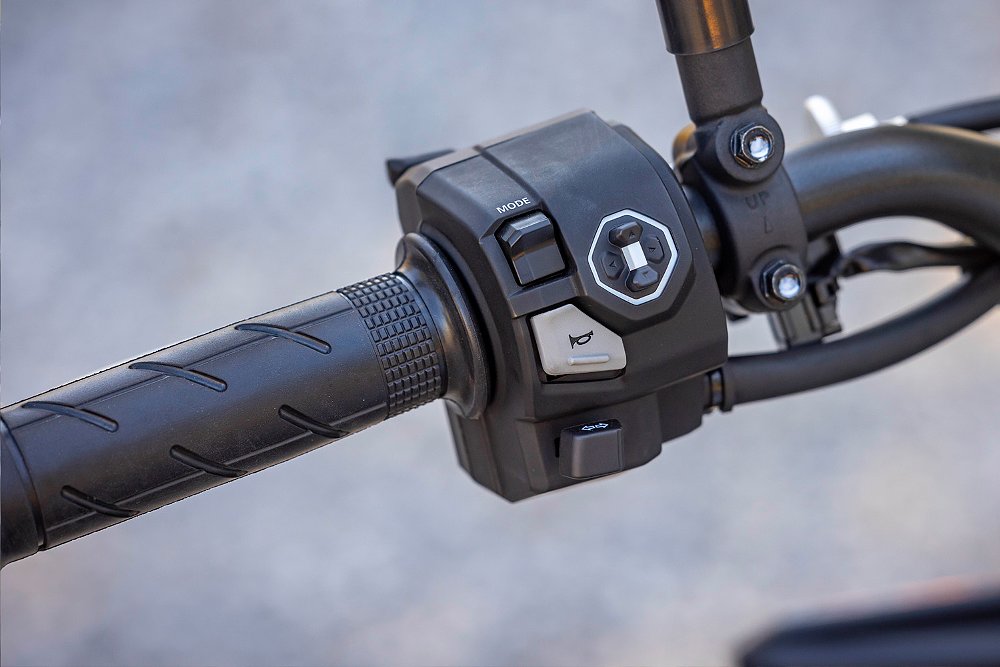
Oddly, the retro machine doesn’t compromise on tech. Like the Hornet SP, the 1000F comes with three preset ride modes (Standard, Sport, and Rain). Two User ride modes allow riders to customize three engine power settings, three engine braking levels, and four traction control options (including off). Thanks to its six-axis IMU, the CB1000F also boasts cornering ABS, something the Hornet doesn’t offer.
While the system features a suite of safety aids, it hardly impedes the ride experience. Other than swapping between ride modes, I largely ignored the five-inch TFT display, focusing exclusively on the road ahead. Sure, the tech is extensive, but it isn’t intrusive. It’s advanced, but it isn’t distracting. Yet again, the throwback CB strikes a balance between then and now, between power and practicality, between modern convenience and in-the-moment presence. It’s that balancing act that separates the Honda from its nostalgia-steeped rivals.
Recovering the "feel"
A period piece, whether it takes place in the 1980s or the 1800s, reflects more about the time in which it’s made and less about the time in which it’s set. The characters, the costumes: all visions of the past viewed through a present-day lens. Its subplots and narratives: more a comment on today, less representative of yesteryear. The same treatment applies to the 2026 CB1000F.
As a brand rep admitted at the model’s press launch, Honda’s bikes have a reputation for being somewhat “vanilla.” It’s easy to engineer the personality out of a motorcycle, especially with the tech-first mindset so prevalent in the industry today. What the CB1000F does best is embrace the character of a bygone era without railing against the modern era. It fuses the best of both periods in one engaging package.
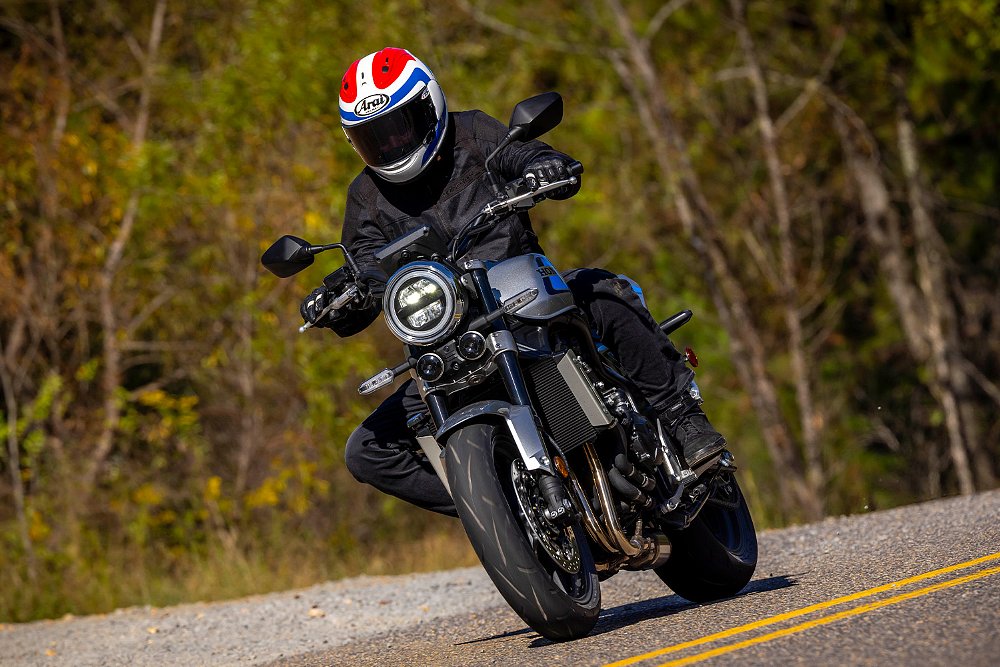
Better yet, the CB1000F is easy to get along with. It’s accessible, it’s welcoming, it’s accommodating — somewhat like the man who’s so closely associated with its two CB forefathers. All the while, it isn’t short on thrills. It’s charismatic. It has personality. It has character. That’s to say, in no way is it a numb experience.
| 2026 Honda CB1000F | |
|---|---|
| Price (MSRP) | $10,599 |
| Engine | 1,000 cc, liquid-cooled, 16-valve, inline four-cylinder |
|
Transmission, final drive |
Six-speed, chain |
| Claimed horsepower | N/A |
| Claimed torque | N/A |
| Frame | Steel twin-spar |
| Front suspension | 41 mm Showa Separate Function Fork Big Piston (SFF-BP), adjustable for preload, compression, and rebound damping; 5.1 inches of travel |
| Rear suspension | Showa shock, adjustable for preload and rebound damping; 5.5 inches of travel |
| Front brake | Dual radial-mount Nissin four-piston calipers, 310 mm discs, with ABS |
| Rear brake | Single Nissin one-piston caliper, 240 mm disc, with ABS |
| Rake, trail | 25 degrees, 3.9 inches |
| Wheelbase | 57.2 inches |
| Seat height | 31.3 inches |
| Fuel capacity | 4.2 gallons |
| Tires | 120/70R17 front, 180/55R17 rear |
| Claimed weight | 472 pounds wet |
| Available | Now |
| Warranty | 12 months |
| More info | powersports.honda.com |