Shop by Vehicle
 Track Order
 Contact Us
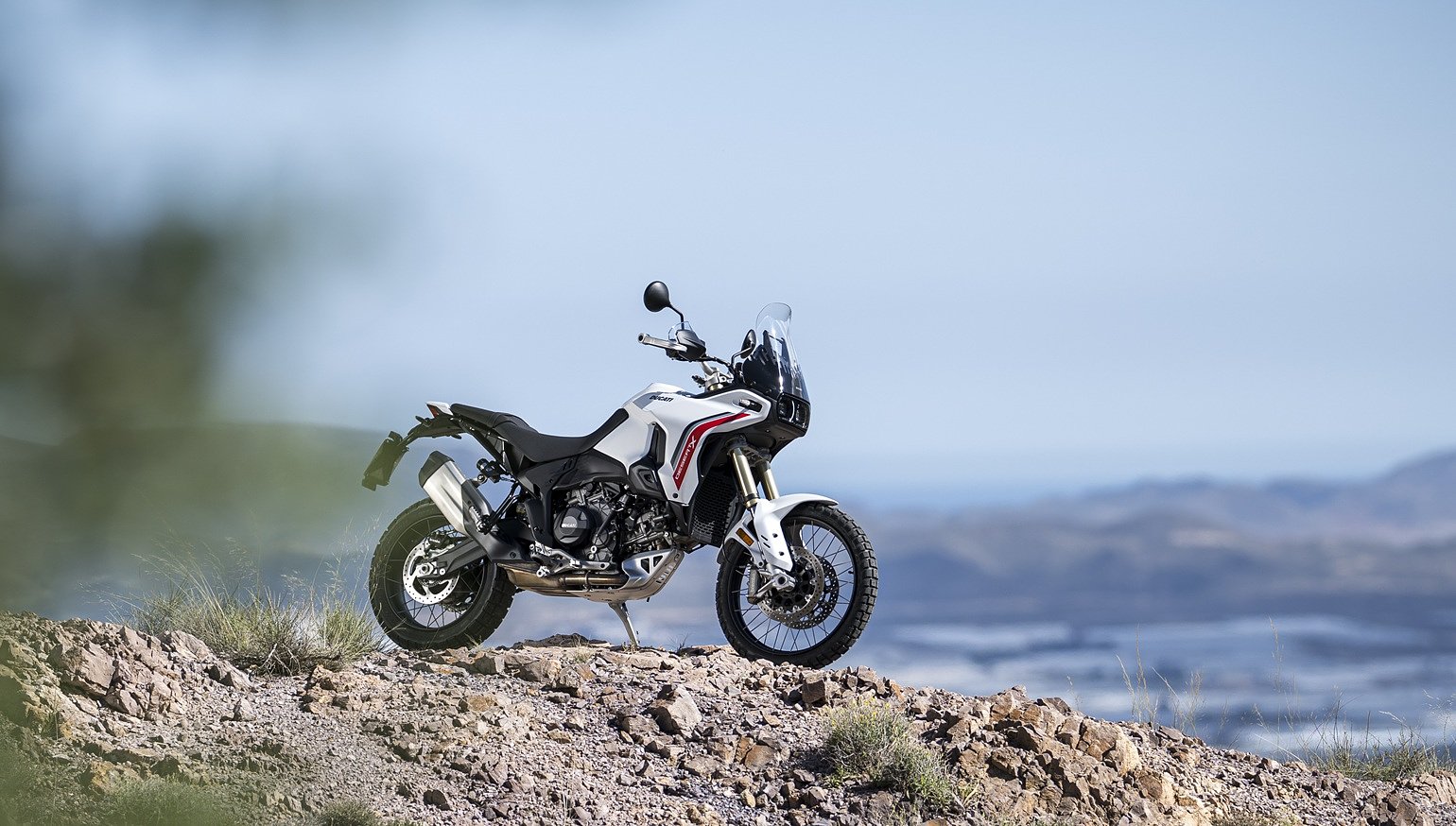
The air filter is usually not the first thing mentioned in a motorcycle review, but I was intrigued as soon as I read that the redesign of the Ducati DesertX for 2026 included relocating the air filter from buried underneath the tank to easily accessible within minutes. It's such a seemingly small change, but it immediately signaled to me that Ducati has taken rider feedback into account in this fully redesigned adventure-touring bike and made it more approachable.
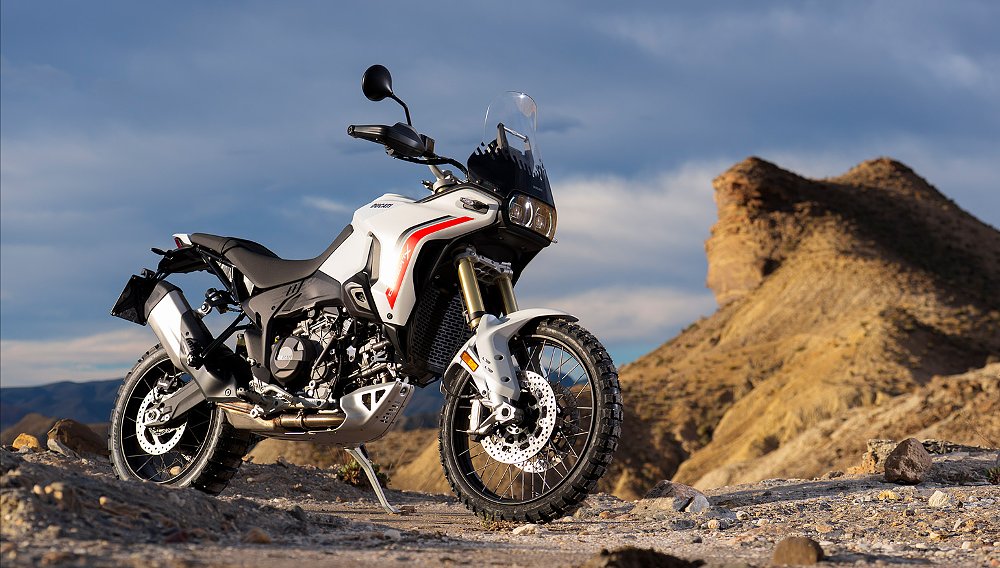
Born from an EICMA 2019 concept and put into production in 2021, the first-generation DesertX immediately won over many adventure-touring enthusiasts with its Ducati styling and engine character coupled with off-road capability signaled by its 21-inch front wheel. This second-generation DesertX aims to further improve its off-road performance while also appealing more to everyday enthusiasts, without sacrificing that Ducati je ne sais quoi. The DesertX keeps its old spirit but not much else. The complete overhaul draws on what the company has learned from years of rider testing and competition in everything from the Erzbergrodeo to the NORRA Mexican 1000 Rally. I'd like to think they also read your forum comment about how cumbersome it was to carry a 36 mm, 12-point socket on your adventure trip for the previous gen's axle nut, or saw the photos of your dented metal tank after that unfortunate low-speed drop. The air filter makes me think that maybe they did.
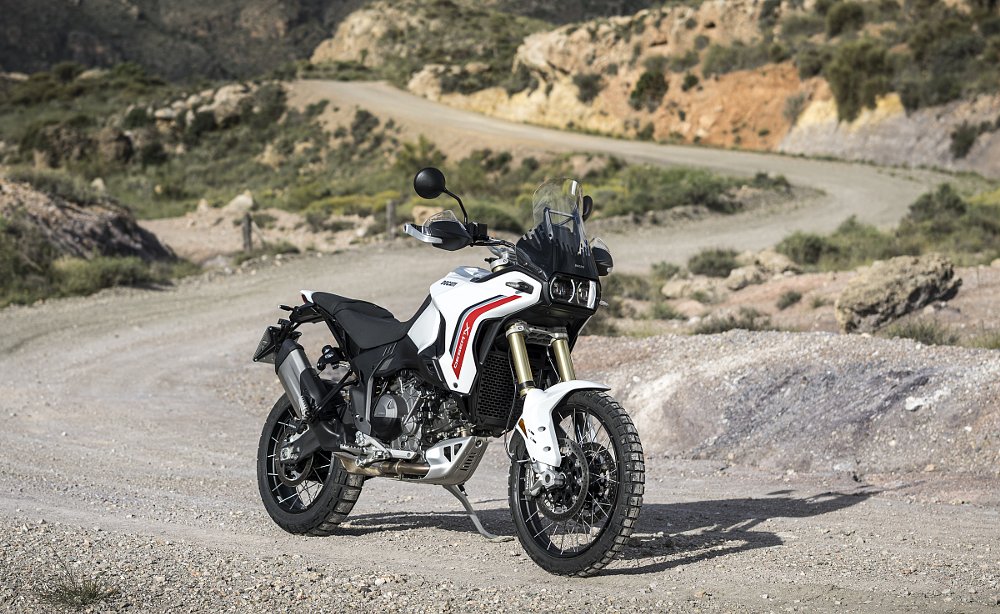
The DesertX joins the V2 line
The DesertX joins the Panigale, Multistrada, Streetfighter, and the Hypermotard in downsizing from the 937 cc Testastretta engine to the 890 cc V2 110-horsepower engine with variable intake timing, designed for a broader spread of torque. Ducati says 70% of the maximum torque value is already available at 3,000 rpm, intended for quick response and better acceleration when exiting corners.
As reported in our first look at the new DesertX, the V2 engine is not only lighter in weight, but also boasts longer service intervals (28,000 miles for valve clearance checks and oil changes every 9,000 miles or two years), a clear response to questions about maintenance costs with the earlier version. Ducati also introduced a new aluminum monocoque frame, a fully adjustable KYB front fork, and a fully adjustable, "full floater" linkage system in the rear.
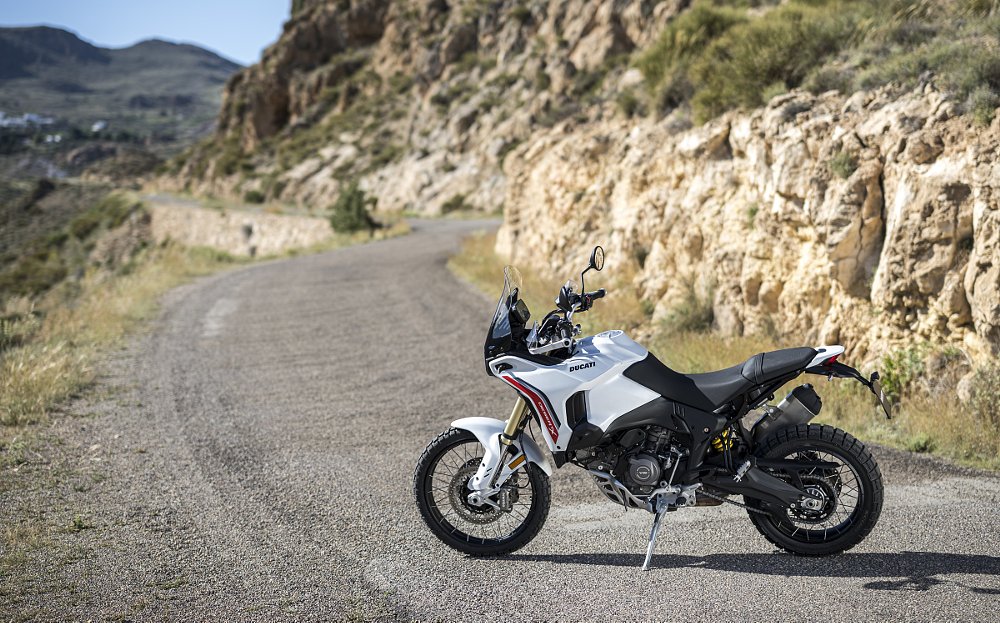
The DesertX is still a big adventure bike, with a claimed wet weight (no fuel) of 460.7 pounds and seat height of 34.6 inches, but the redesign shifted the weight distribution and narrowed the seat to improve its overall balance and ground reach. It carries 4.8 gallons of fuel. It rolls on 21-inch front and 18-inch rear Pirelli Scorpion Rally tires spooned onto cross-spoked tubeless wheels. And of course the new DesertX is equipped with a latest-generation electronics package that offers adjustable intervention of Cornering ABS, Ducati Traction Control, Ducati Wheelie Control, and Engine Brake Control. One of the best updates for 2026 is its MSRP of $16,995, $2,000 less than the first-gen DesertX in 2025.
Before going to Almería, Spain to test the new-generation DesertX, I prepared myself by spending some time on the first-generation BDR "Cross Continent Special Edition" Ducati DesertX that a friend of mine won through BDR's raffle in 2024. I rode out to meet him and we swapped bikes — his DesertX for my Yamaha Ténéré 700 — and we twisted through some of Pennsylvania's tight and winding paved roads and romped down unmaintained gravel stretches. And after a day on this heavily modded, first-generation bike, I felt ready to evaluate the boasted improvements. I personally hoped that the narrower seat really did improve rider reach, because I could barely get a foot down on the top-heavy first-gen with my 32-inch inseam and I really didn't want to drop this bike in front of two dozen peers. I anticipated that the gearing and suspension adjustments would improve its off-road capability. And I was curious how much of the original character the new DesertX would keep despite all of the changes. Would it still have the same punch, the same high-end engineering, the same throwback nod with the new engine and refreshed, more modern aesthetic? And I carried with me the question about whether the updated rider experience would really invite a broader segment of riders to enjoy this motorcycle, as Ducati hoped it would.
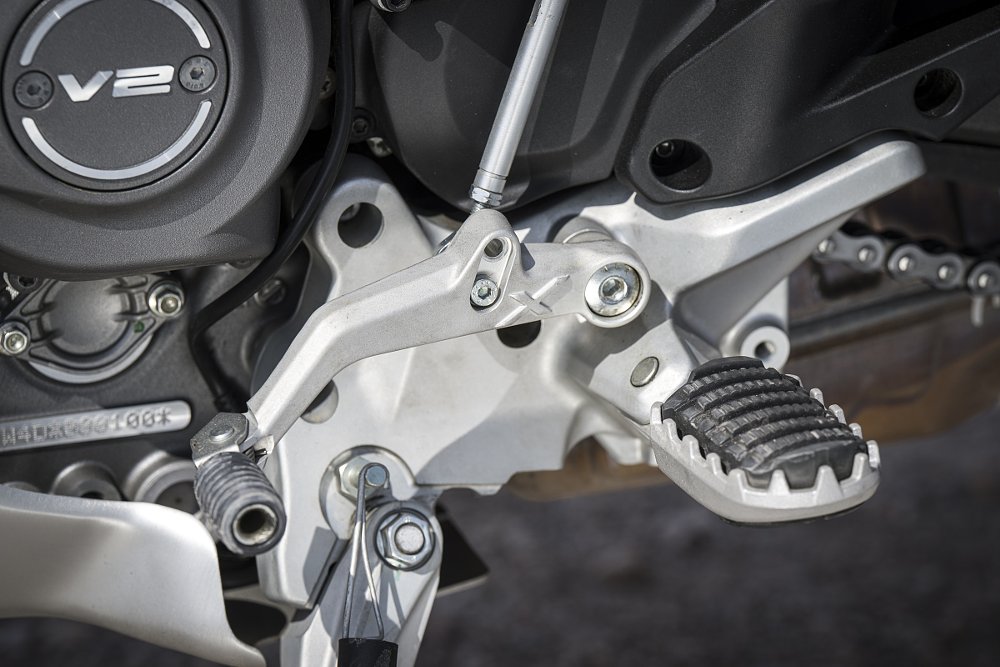
Warm and bright, the morning sun in Almería beckoned us into the mountains. We were to start in the coastal plain and ride through the Tabernas Desert up into the Sierra de los Filabres mountain range. The air was fragrant like honeysuckle as 35 or so DesertXs parked in perfect formation snarled as they warmed up. I took advantage of the fully adjustable Brembo clutch and brake levers, and leaned down to pull the rubber insert out of the footpegs. Mid-removal, I was stopped and encouraged by a Ducati engineer to leave it be for the initial portion of the ride, as it reduces vibration and was designed to compress below the footpeg spikes anyway when the rider is standing. The rear brake pedal then was adjusted to the lower setting for street riding — a quick, two-second spring-loaded change. I checked the windscreen for adjustability, but even after the redesign, it is still not adjustable.
As I pulled the bike up off of the sidestand, I was relieved to experience that the narrower seat and slimmer gas tank did indeed place me closer to the ground. While the bike is still very tall, I could get two tiptoes down at once, an improvement over the first-gen. Ducati also offers a low seat and a low suspension kit, which bring the seat height down a more accessible 33.1 inches. For taller riders, a rally seat raises the height to 35.4 inches.
I navigated through the ride modes — Wet, Sport, Touring, Urban, Enduro, and Rally — and noted the calibration of each with regard to the accessibility of power, availability of the quickshifter, and intervention by ABS, traction control, wheelie control, and engine brake control. Sport mode, for example, cranks up the power, punches up the throttle response, and has a higher ABS interference, while Wet mode reduces the power from 110 horsepower to 95 horsepower, smooths out the throttle response, and ups the traction control. I selected Touring mode for the initial paved ride up into the mountains: medium power, medium-high traction control, and low engine brake control.
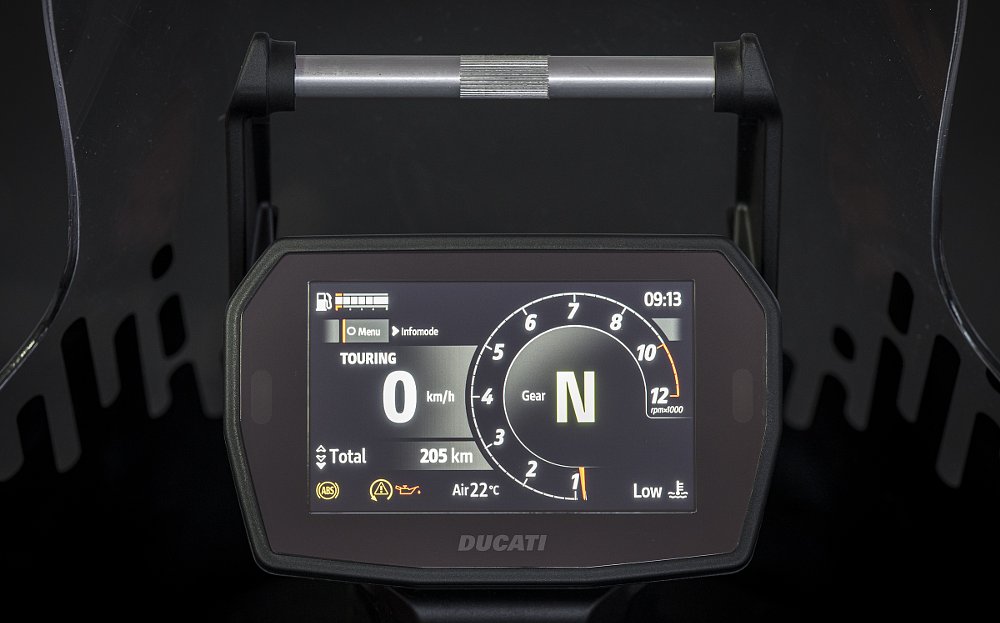
I toggled through three versions of dash info display, Road, Road Pro, and Rally, and selected Road Pro for the start. Each display shows different info to the rider, with the Rally display even allowing for in-the-moment individualization of each ride mode — within the limits Ducati has deemed appropriate. For example, while riding, in the Rally dash view, in the Enduro mode, I can toggle through and edit traction control interference to any value between OFF and 4. There are ultimately eight levels of traction control, but Ducati limits the adjustability of Enduro mode to the traction control levels appropriate for off-road riding, so levels 5 through 8, which are intended for street riding, aren't available in Enduro mode.
If you customize the settings in a ride mode, the DesertX saves them so you don't have to dial in your adjustments every time you start the motorcycle. There's one predictable caveat, however. If you turn off ABS in either of the off-road modes, once you turn the key off, the ABS selection will reset to the standard setting. For Rally mode that's 1 (rear ABS off and minimal front ABS interference) and for Enduro mode that's 2 (minimal front and rear ABS intervention).

Riding the Ducati DesertX, on- and off-road
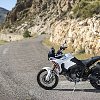
We clicked into gear and were off, filtering through in-town roundabouts and, within minutes, pulling onto the autopista. Seated, the windscreen appropriately passed good quality air over the cockpit, a noted improvement over the first-gen. Our group made quick work of the ride into the mountains. We turned off of the highway onto a narrow road through a small mountain town and then up to a twisty mountain pass, the desert landscape widening below. I toggled into Sport Mode, closed the throttle to activate it, and immediately felt the throttle response sharpen. I found the ergonomics to be comfortable for seated road riding: a wide handlebar, a narrow tank, and it was easy to move around on the seat. At five feet, seven inches tall, I had no problem seeing over the windshield, though in the photos the screen looks tall and it appears I'm sitting low.
We further snaked our way up the mountain. The engine was lovely: shorter gear ratios in the lower gears, higher in sixth gear, and yet happy to pull deep into higher rev range before I had to shift. The DesertX still doesn't love to lug the engine. In the prior version, I felt it was begging me to shift at specific intervals, but with the new V2 engine, the power is accessible across wider rev ranges. That meant my upshifts weren't quite as urgent, especially in this technical mountain pass where overall speeds were moderate.
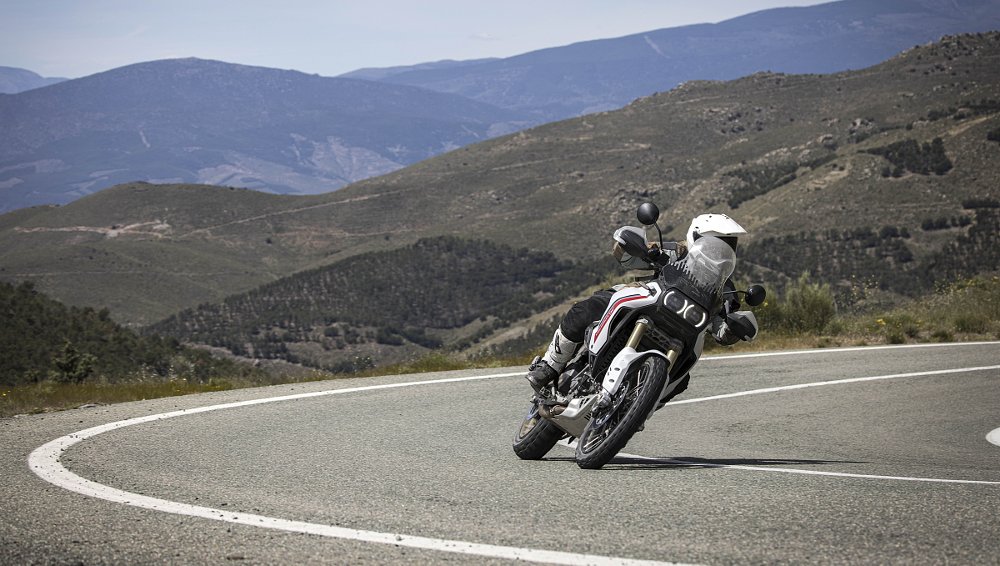
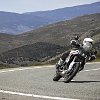
The cliff's edges were steep and the curves tight. A quick downshift gave me access to that additional engine braking into a turn, and the bike pulled powerfully back out. Downshifting is where the new bidirectional quickshifter really shined. And the distinct, deep rumble of the engine braking was quite satisfying. The front never wallowed with heavy front braking in Sport mode. I had great confidence going into corners as the front suspension compressed but didn't bottom. Ducati says the new DesertX's longer wheelbase makes it a more planted and stable motorcycle, but in hard cornering that long wheelbase made the front tire feel like it was out ahead of me, reducing feedback. It is, after all, still an ADV bike with a 21-inch front tire, one that was deliberately redesigned to change its balance, placing more weight lower and on the rear. As a result, while the DesertX certainly had a dynamic, sporty character on the street, it is not a sport bike.
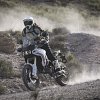
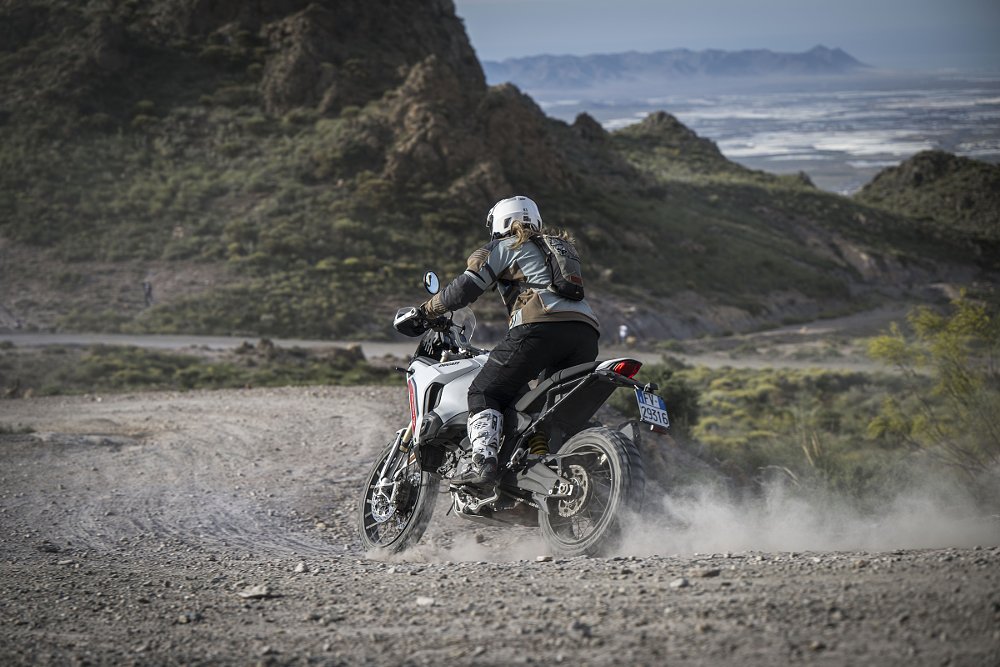
We made it up the mountain to Huebro, where we turned off onto a gravel road, toggled into Enduro mode, and stood up on the pegs. It was immediately apparent how much of the redesign was focused on improving the off-road ergonomics and character. The bike's stability here was more appreciated, the narrow polymer tank comfortable to grip. At our first stop on the gravel, I reached down to click the rear brake lever into its higher off-road position and popped the peg inserts out for better grip.
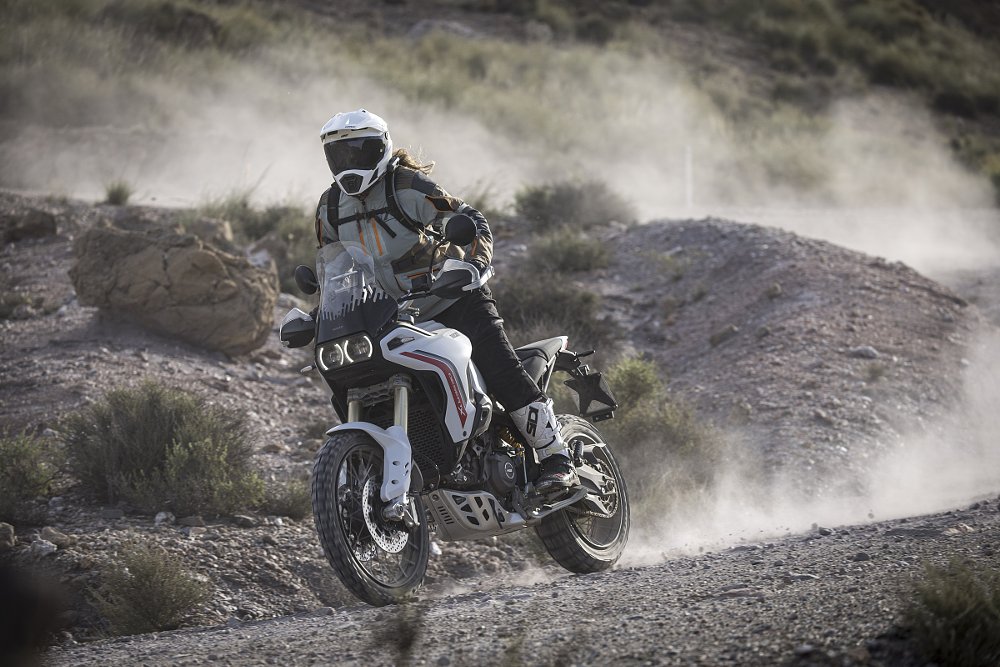
Standing, the rider triangle felt more comfortable than on the previous DesertX. With the handlebar further forward and the pegs further back, it felt easier and more natural to get my body up over the tank. In Enduro mode, the ABS interfered some, but still felt appropriate for our smooth, winding gravel passes. Ducati describes ABS 2, the setting in the Enduro mode, as the off-road beginner setting, where the ABS allows for gradual intervention and brief lock-ups of the rear wheel. The ABS 1 setting, or their off-road expert setting, available in the Rally mode, removes ABS on the rear wheel completely. When we made it down into some rockier terrain with a few washouts, I preferred the ABS 1 setting and the lowest traction control, and didn't feel that I ever had to turn the ABS off to further reduce interference.
We stopped for a quick coffee break in the desert mid-morning. The area's lunar-like landscapes famously served as the backdrop for classic Spaghetti Western movies. (Do I make an Italian spaghetti joke here?) The sun was warm, all of the vents in our gear wide open. It was here I noticed how much cooler the bike was running. The weekend prior, on the first-gen, it almost felt like I was on a heated seat. Ducati did introduce a water-oil heat exchanger in the new-gen, and I suppose it was doing its job.
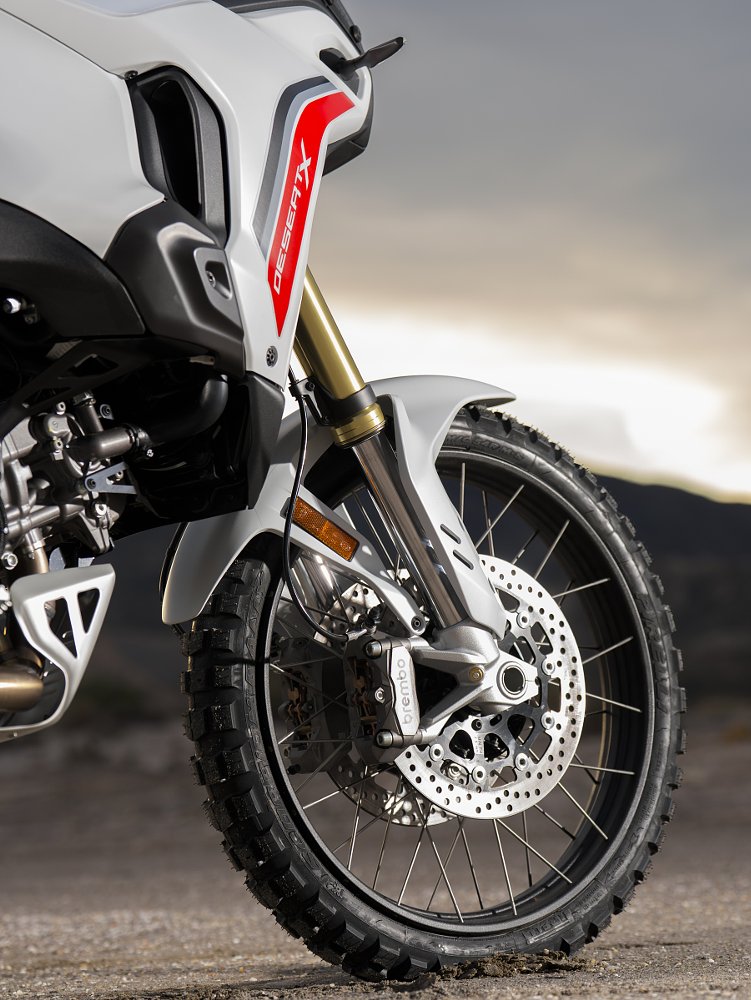
Caffeinated, we rolled out to do some more gravel twisties. The mountain passes outside of Almería seemed to have no end... well, except for the intimidatingly steep drop-offs on either side. One of the major changes Ducati highlighted in the new-gen DesertX was switching the front brake caliper to a radial mount with a smaller front disc, intended to reduce that initial bite upon braking. It may be slightly less severe, but that first braking response was still immediate. I did pick my way through a handful of bad lines, and I felt there was adequate lever feel for deliberate low-speed off-road brake modulation. Here, in these low-speed maneuvers, is also where the shorter initial gears came into play. I imagine it would do well through tougher obstacles, thanks to these new-gen updates.
Overall, the bike felt stiff but compliant. The rigidity of the new chassis worked with the upgraded suspension to deliver predictable response to my inputs. The additional adjustability of the suspension contributes here. In the new-gen DesertX, compression and rebound can be adjusted on each fork leg. In the old-gen, the fork was split: one had compression adjustment and the other rebound. I counted 20 total clicks of front compression adjustment, and we ran 14 from fully closed. The front rebound damping was set one turn of three from fully closed.
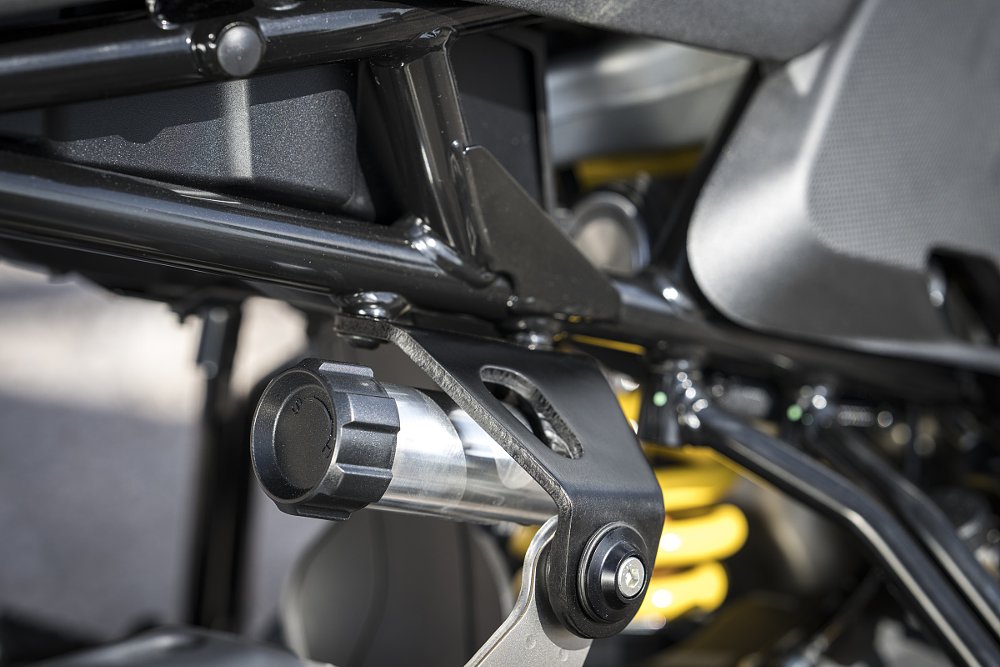
In the rear, the new DesertX features a progressive linkage shock under the seat. This is a huge change over the first-gen's direct-mount shock. The progressive linkage is intended to provide a more pliant feel in the early part of the stroke and markedly increased support as the suspension compresses under heavier hits. I felt the rear compression damping was adjusted well at 12 clicks from fully closed. We were running rear rebound damping one turn of three from fully closed. I felt some deflection in the rear, and adding a bit of rebound quieted the deflection. With more time, I felt like I could really dial this in, given the range of adjustability.
The steering damper is still exactly where I'd want to hang a bar bag or nestle a tank bag. I can't see a world where it isn't interfering with aftermarket front baggage solutions. The go-to OEM tire for ADV bikes, the Pirelli Scorpion Rally STR 50/50 tires, with which the DesertX comes standard, performed well on the gravel passes and shallower sand washes. Should I have wanted more tread depth for more challenging terrain, the standard-size wheels allow for a wide range of replacement options in varying levels of aggression.
After a delicious lunch at an asador in rural Gérgal, we raced back to the coast down a narrow paved pass. As we rode, our mirrors brushed past the yellow Spanish broom, releasing fragrant bursts of sweet honey into the air. The desert air was still warm, the sky blue and clear. And then as quickly as we had made it into the mountains, we were back filtering through roundabouts and past plastic greenhouses laden with fresh fruits and vegetables.
We pulled back into town after eight hours and 124 miles. While the 4.8-gallon fuel tank on the new DesertX is 15% smaller than the previous generation's tank, less fuel means a lighter overall motorcycle, and most of my adventure-riding friends are going to need to stop before 200 miles, the DesertX's approximate fuel range, to fuel up their own bikes, anyway. Should more fuel capacity be needed, an auxiliary rear fuel tank raises the capacity to 6.9 total gallons.
A weighty question
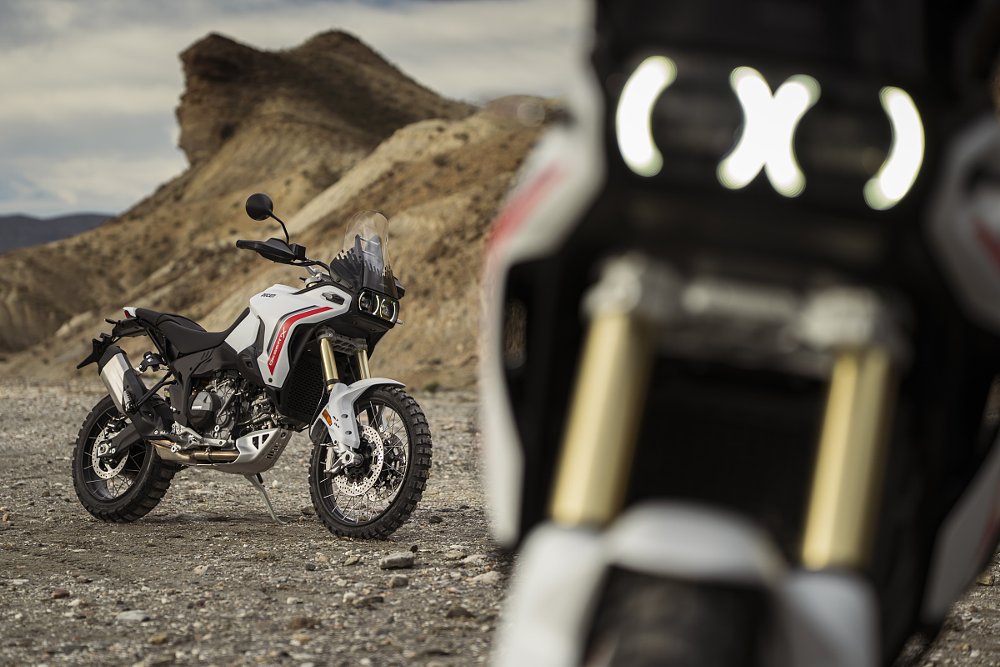
Some of the other Ducati models that switched to the V2 engine lost some weight. Going into this test ride, I had questions about why the DesertX had only lost a few pounds despite the redesign, and I couldn't understand why making the bike actually lighter hadn't been part of the equation. A day of riding quieted those questions. Ducati engineers prioritized high-end components over cutting weight, so while they saved weight with a lighter engine and a lighter tank, for example, they added weight in components like the aluminum frame and the suspension linkage, two changes that truly enhanced the total package. And the bike did feel lighter, thanks to its slimmer frame and more balanced center of gravity.
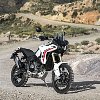
I did miss some of that true retro Cagiva styling lost to the more contemporary makeover. The lines are a bit more chiseled, the large dinner-plate headlights given a slight squint. Don't get me wrong, it's still a gorgeous motorcycle with distinct styling: the iconic white livery, the rear trellis subframe. It still growls and performs like a Ducati; its looks have just been brought a bit more into the modern era.
DesertX against the competition
The changes to Ducati's new-gen DesertX seem to position the bike better among the class leaders from the likes of KTM and Honda. With better off-road performance, longer maintenance intervals, and a lower price point, it emerges as a true contender rather than a niche, pro-component offering. Even with its aesthetic redesign, it's the best-looking bike in the class, to my eye. It's more powerful and better off-road than the Honda Africa Twin. It boasts more power than the BMW F 900 GS, though the BMW wins on price. It covers a broader scope of riding domains than the KTM 890 Adventure R, a bike I recently had in my own garage. The DesertX transitions better from dirt to street, while the KTM 890 Adventure R is more of an off-road-focused machine. Against the Triumph Tiger 900 Rally Pro, the DesertX wins on price, but shares characteristics like adjustable suspension and robust electronics.
But who is going to choose the DesertX over the rest? According to Ducati, the redesign is meant to invite a broader range of riders to enjoy its features. The perception of the first-gen was that it was meant for adventure riders who wanted a showpiece and were seeking power and pro-components over something more practical. What about riders who want the convenience of longer maintenance intervals or an easier time changing an air filter? This redesign invites them to consider the DesertX, too.
The DesertX's advanced electronics make it both fun and safer to ride on the road and impressive and capable off-road. It boasts many of the non-negotiables on many adventure riders' lists: spoked tubeless wheels, cruise control, adjustable ABS, lots of power, traction control, adjustable suspension, good balance, decent fuel range, great looks, an effective windscreen, and a fair price (especially now that it's $2,000 less than the first-gen DesertX). Along with that, it retains that coveted Ducati character: dynamic power, handsome livery, and high-end engineering. And now, you can even easily change the air filter.
| 2026 Ducati DesertX | |
|---|---|
| Price (MSRP) | $16,995 |
| Engine | 890 cc, liquid-cooled, eight-valve, L-twin |
|
Transmission, final drive |
Six-speed, chain |
| Claimed horsepower | 110.3 @ 9,000 rpm |
| Claimed torque | 68 foot-pounds @ 7,000 rpm |
| Frame | Aluminum monocoque |
| Front suspension | Kayaba 46 mm inverted fork, adjustable for preload, compression, and rebound damping; 9.1 inches of travel |
| Rear suspension | Kayaba shock, adjustable for preload, compression, and rebound damping; 8.7 inches of travel |
| Front brake | Dual Brembo M4.32 four-piston calipers, 305 mm discs with cornering ABS |
| Rear brake | Brembo two-piston caliper, 265 mm disc with cornering ABS |
| Rake, trail | 27.0 degrees, 4.5 inches |
| Wheelbase | 63.6 inches |
| Seat height | 34.6 inches |
| Fuel capacity | 4.8 gallons (optional 2.1-gallon rear tank) |
| Tires | Pirelli Scorpion Rally Street, 90/90-21 front, 150/70R18 rear |
| Claimed weight | 461 pounds (no fuel) |
| Available | Now |
| Warranty | 24 months |
| More info | ducati.com |