Shop by Vehicle
 Track Order
 Contact Us
The year was 1976.
“Take It to the Limit” by the Eagles ruled the airwaves.
Farrah Fawcett posters hung on every teenage boy’s bedroom wall.
Still, for budding motorcycle buffs, no cultural moment was more significant than the introduction of the AMA Superbike Championship.
The popularity of big-bore bikes exploded in the early to mid-’70s. Answering the call was the new Superbike class, which welcomed the multi-cylinder four-stroke machines — as long as they didn’t exceed 1,000 cc. The rulebook wasn’t much more complex than that. Teams took full advantage of those loose guidelines, too, overhauling both the chassis and engine internals. One outfit in particular pulled off the improbable as a result.
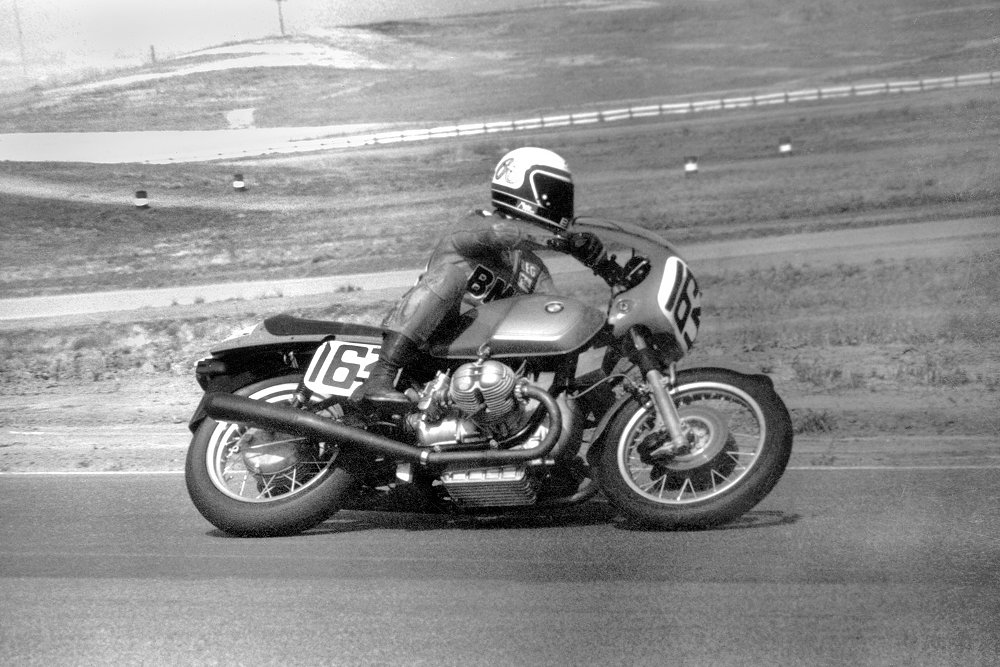
The Teutonic Tourer
Horsepower was king back in the day. Well, for Japanese OEMs, it was. Models like the Kawasaki Z1 were synonymous with raw power. Agility was an afterthought. That explains why Japan’s inline-fours, including Honda’s legendary CB750, couldn’t keep up in the corners with the lithe handling of Ducati’s 750SS and Moto Guzzi’s 850 Le Mans. Those bikes drew on the racing lineages of both brands. No such associations were made with BMW’s R90S.
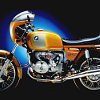
In those days, BMWs were regarded as touring bikes for old men. Beemers made for geezers. In part, that’s what earned the R90S the nickname “Teutonic Tourer.” Terms of endearment aside, the boxer-powered cafe racer was a viable Superbike platform, but only in the hands of chassis specialist Todd Schuster and engine tuner Udo Gietl.
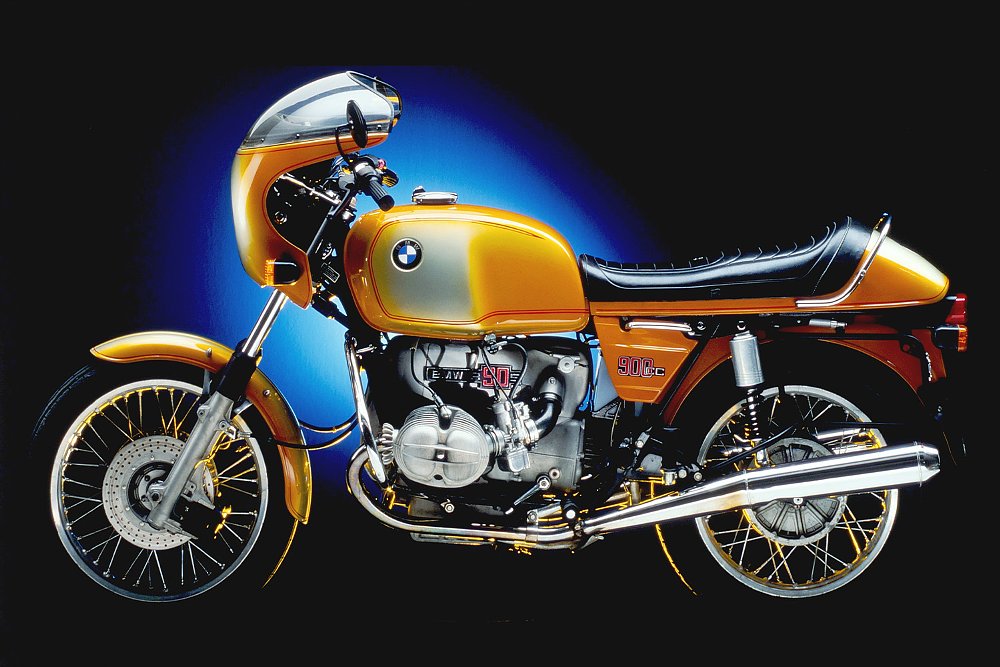
The Brooklyn-based BMW importer Butler & Smith began customizing /5 Series bikes for the AMA Formula 750 class by 1971. Gietl was instrumental to the project, helping to develop the R75/5-derived F-750 race machine. While those efforts put him on the map, it was the R90S project that cemented his legacy in Superbike lore.
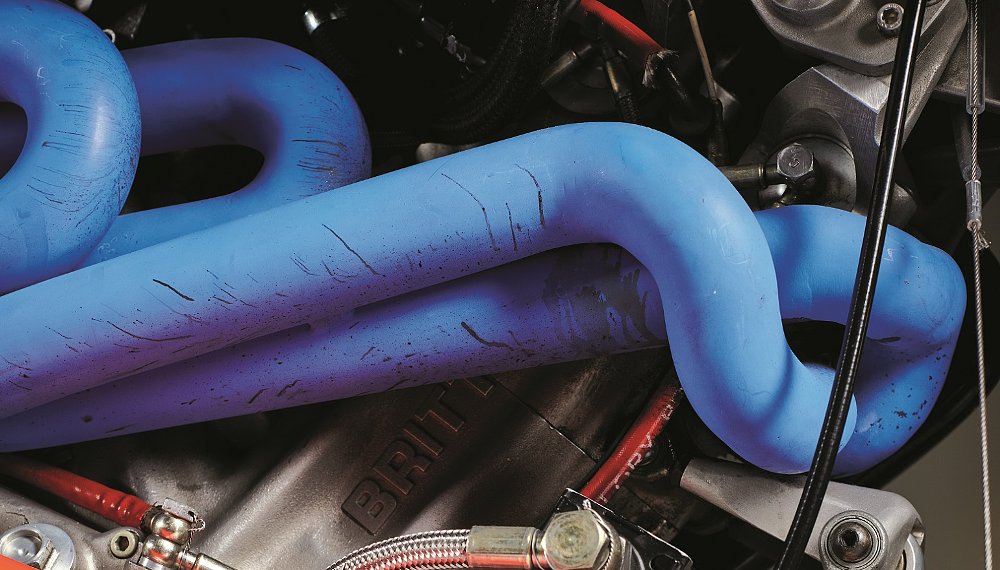
Many of the strategies Gietl employed on the Slash-Five racers were carried over to the R90S. That goes for the shortened cylinders, which kept the opposed twin’s outboard heads from touching tarmac at high lean angles. Cornering clearance wasn’t the only objective.
Compensating for the reduced stroke was an increased bore that pushed the engine's capacity near the class’s 1,000 cc threshold. The conrods were titanium. The carbs were 38 mm Dellortos. In turn, the race-prepped R90S pumped out 100 ponies (at 7,000 rpm), a considerable increase over the stock bike’s 65 horsepower rating.
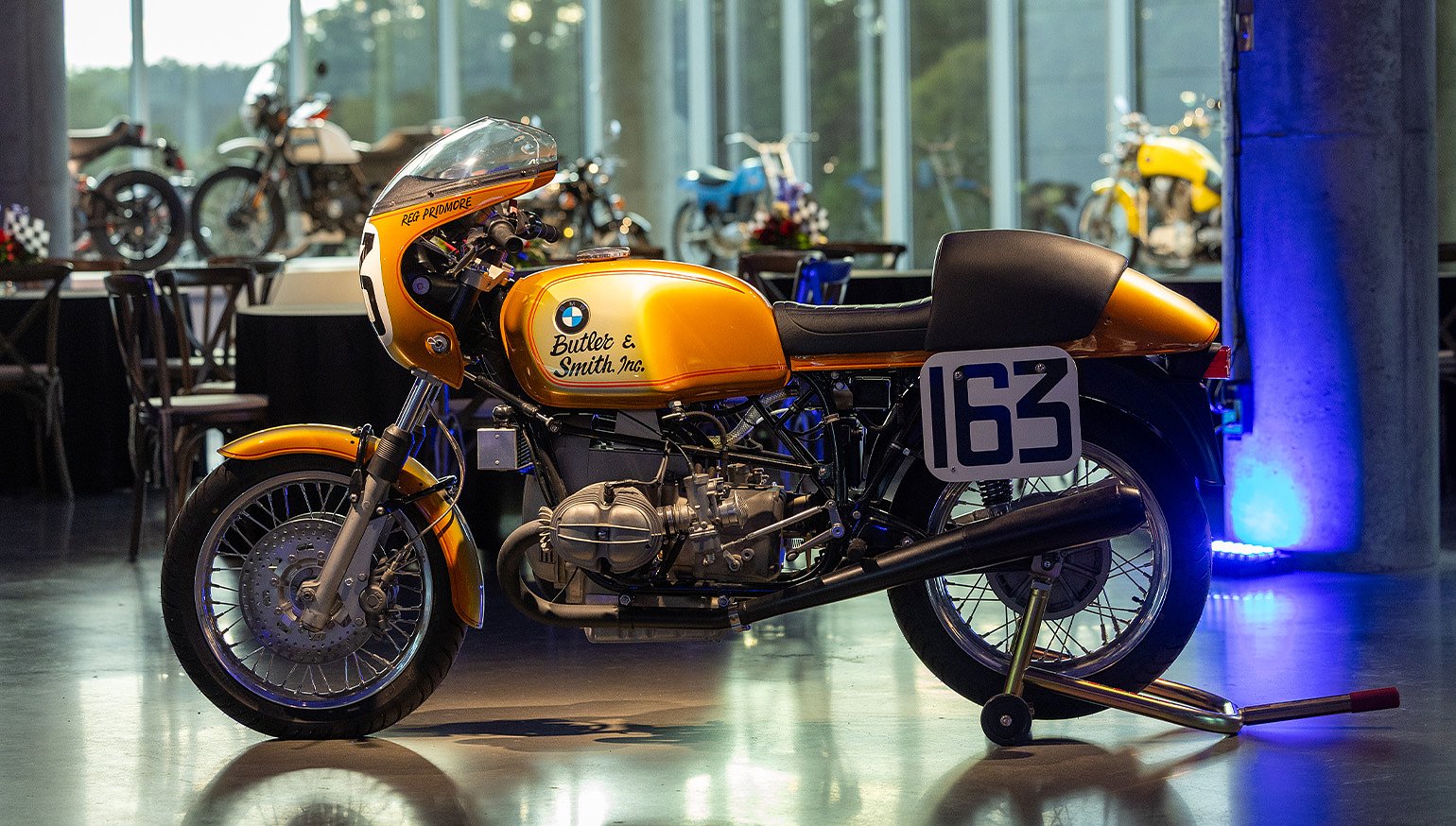
The chassis modifications were just as transformative. A brace between the steering head and swingarm pivot point aided the frame’s rigidity. A race-proven Ceriani fork fortified the front while larger brakes did what larger brakes do. However, it’s the rear suspension that raises the most eyebrows. The team not only did away with the production model’s dual shocks in favor of a monoshock setup, but did so by adapting a Koni shock meant for a car.
The R90S race bikes were unconventional. That’s undeniable. The results they achieved were just as undeniable.
Sweeping the standings
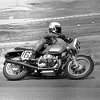
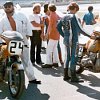
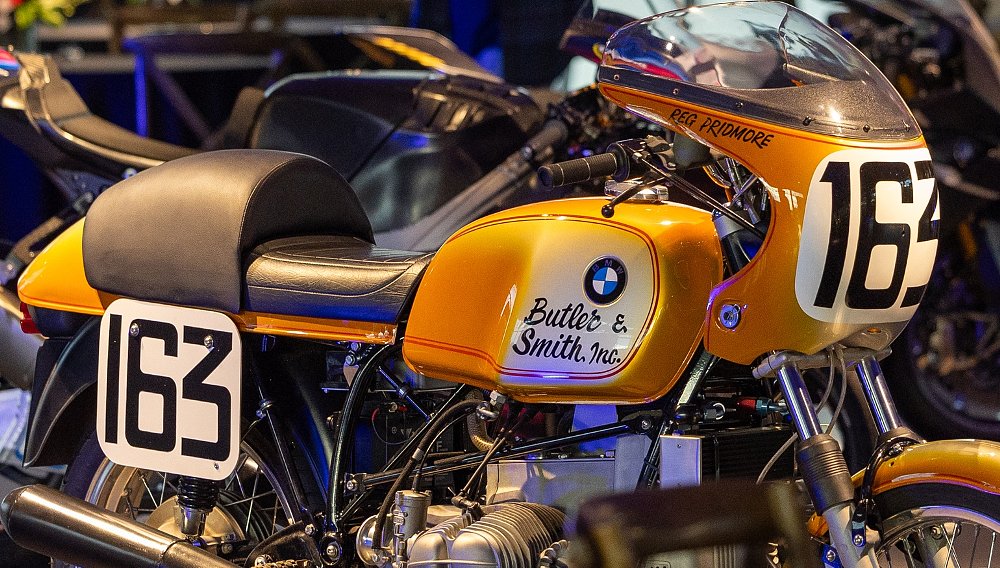
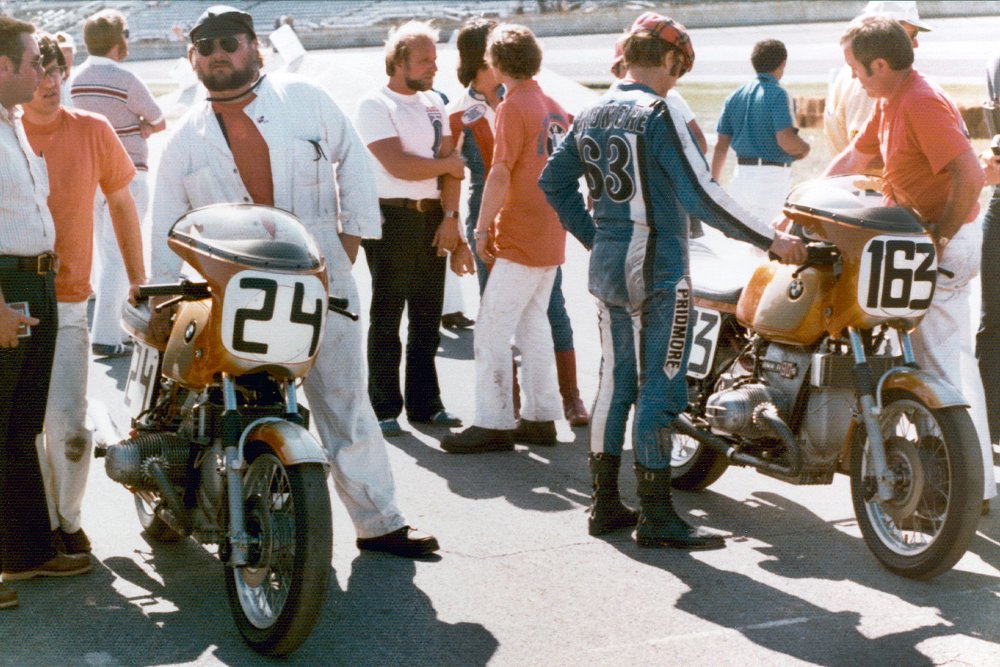
In 1976, Butler & Smith BMW fielded three R90Ss in the inaugural AMA Superbike Championship. To pilot the trio, the firm tapped Gary Fisher (#24), Daytona 200 vet Steve McLaughlin (#83), and Reginald “Reg” Pridmore III (#163), an accomplished racer in his own right and the owner of a BMW dealership near Santa Barbara, California. The outfit proved its pedigree from the very first race at Daytona, with McLaughlin earning a photo-finish win over his teammate, Pridmore.
“I used to never look back. I used to tell people, stop looking back,” Pridmore said in reference to the ‘76 Daytona race. “What did I do? I took a look back, and [McLaughlin] was drafting me.”
Armed with that experience, Pridmore didn’t look back the rest of the season. Neither on the track nor in the standings.
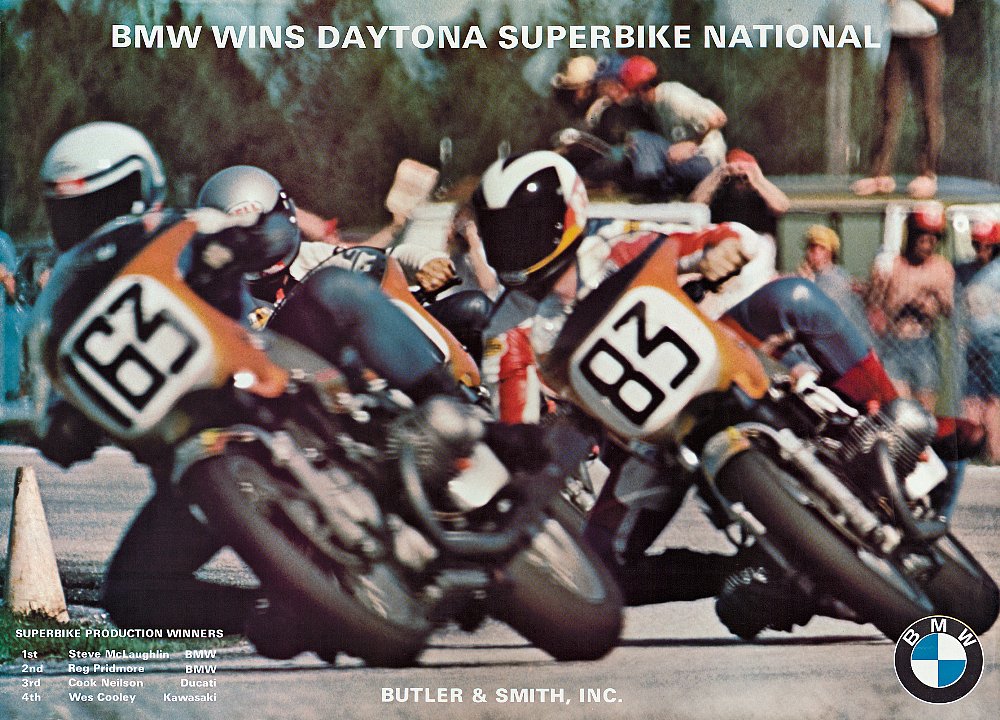
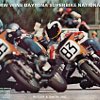
The Moto Guzzi-mounted Mike Baldwin claimed victory at the second round in Loudon, New Hampshire, but the Butler & Smith team wasn’t far behind, with Fisher and Pridmore rounding out the podium. With the championship lead in his possession, Reg went on to win the two remaining races at California’s Laguna Seca and Riverside International Raceways.
By the time that Wild Cherry’s "Play That Funky Music" topped the charts in October, Pridmore claimed the 1976 AMA Superbike title, with teammates McLaughlin and Fisher finishing second and third (respectively) in the year-end standings. It was an imperious performance by Butler & Smith BMW. Unfortunately, it was short-lived.
The more things change…
In 1977, Pridmore repeated as AMA Superbike Champion, but he did so on a Kawasaki Z1. That sophomore Superbike season marked the arrival of the Japanese. Out of the 50 AMA Superbike titles awarded, 45 of them were won on the back of a Japanese steed. BMW may have dominated the inaugural season, but it practically disappeared in the following decades.
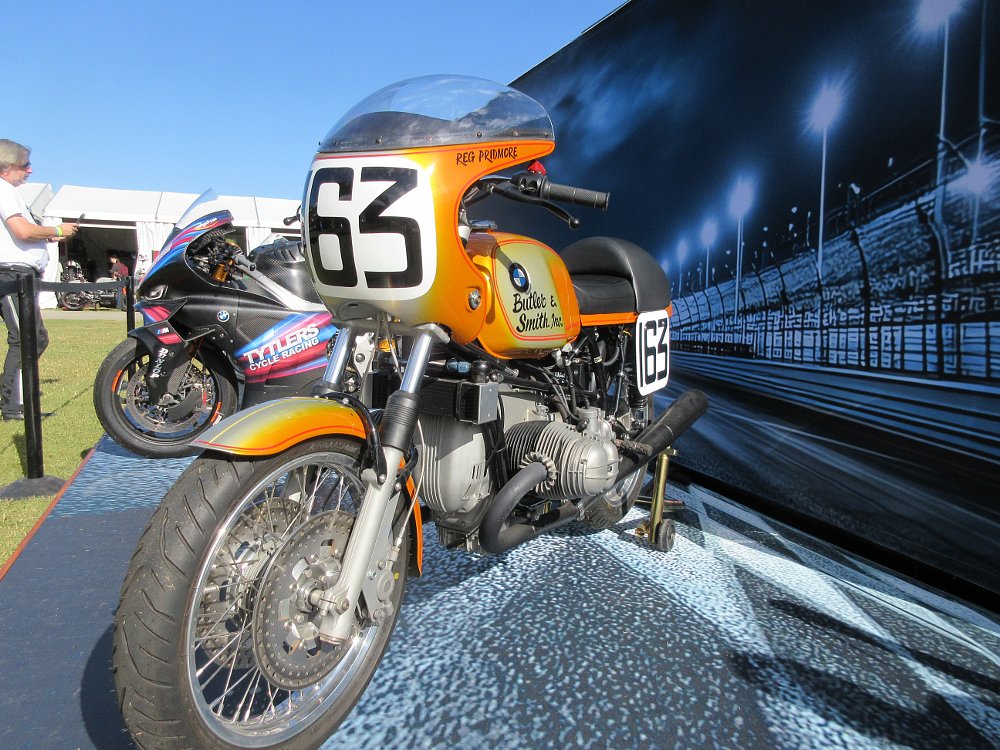
The Bavarians only returned to championship form last year, with Cameron Beaubier completing an improbable comeback late in the year. Sadly, that success was short-lived, too, as the Tytler's Cycle Racing team dissolved at the end of 2025. As a result, Beaubier will ride for Warhorse HSBK Ducati in 2026.
Superbike racing has come a long way in the last half-century. From air-cooled engines to predictive rider aids, from carburetors to carbon fiber, the series is more advanced than ever. Yes, the sport is more tech-driven than ever, but the same enterprising spirit that pushed Butler & Smith BMW to the title is still present to this day.
Image Gallery