Shop by Vehicle
 Track Order
 Contact Us
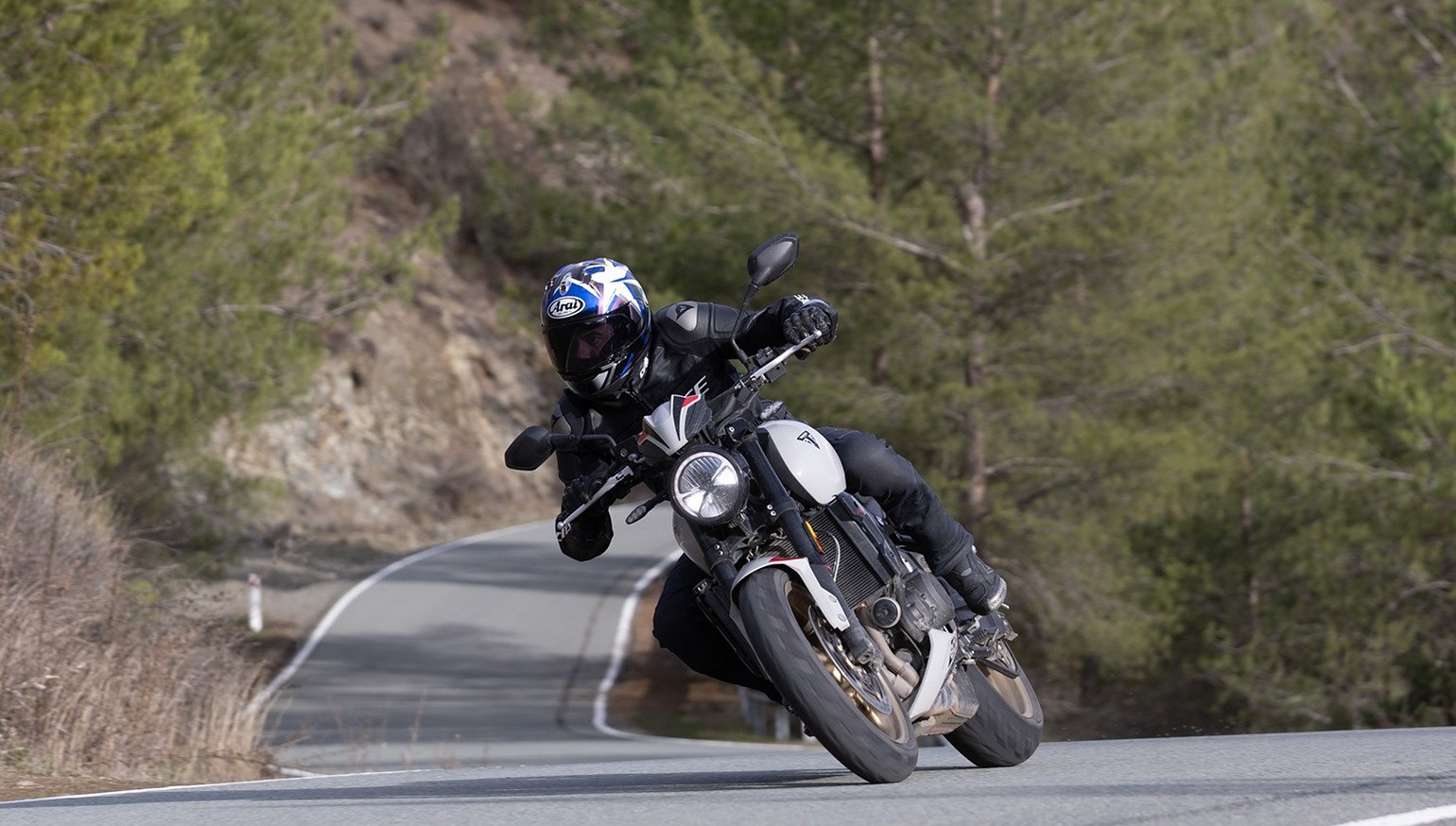
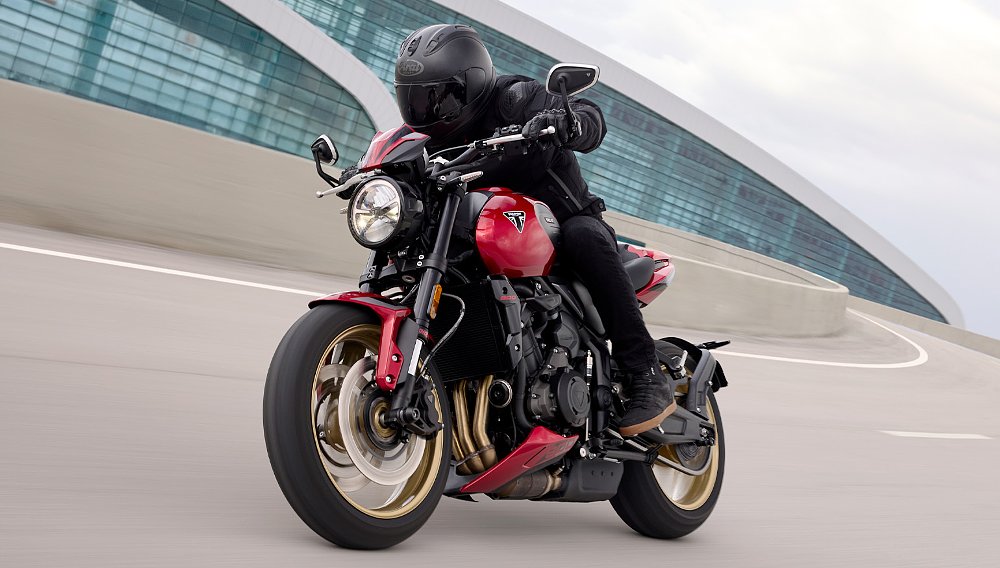
It was roughly 25 miles after the lunch stop in our first ride of Triumph's Trident 800 in Cyprus when it hit me — I had been transported all the way back to 2009.
Back then, Oasis had just broken up, Uri Geller had bought himself a Scottish Island, and Barack Obama had won the Nobel Peace prize… but there was bigger and more significant news: I'd bought my second big-bike, a Triumph Street Triple 675 R in Matte Graphite Grey. What I had realized, as I gassed out of yet another billiard-table smooth corner, was that if I was 24 again, my second big bike would have probably — no, almost definitely — been a Trident 800.
This is of course entirely by design: Triumph has now discontinued the Street Triple 765 R. There's a few models left in showrooms, but they're no longer rolling off the production line, and Triumph explicitly calls out the Trident 800 as the Street Triple R's successor. On the face of it, that makes complete sense because over the years the Street Triple has become an ever sharper, powerful, more capable proposition. I suppose, therefore, asking it to be able to act out an "R" version, as well as an RS, Moto2, and now RX, was starting to look like a very tall order; one that had begun to demand too much compromise. It's akin to asking your washing machine to do the washing, drying, and now the ironing, as well. It's not really possible.
With the Trident 800, Triumph has allowed the Street Triple to take a fork in the road in pursuit of fast-road and track excellence, and appointed this — the Trident 800 — to take care of the "pure roadster" duties.
On that note, Triumph semi-replicated the "Top Gear" studio in an urban warehouse just outside of Limassol (albeit with less slapstick humor and more reading quotes directly from laptop screens) to explain how the Hinckley crew had put the Trident 800 together. It highlighted who it thinks the customer is, at which point in their career they'll buy it, and why, and then went on to outline the perceived competition, too.
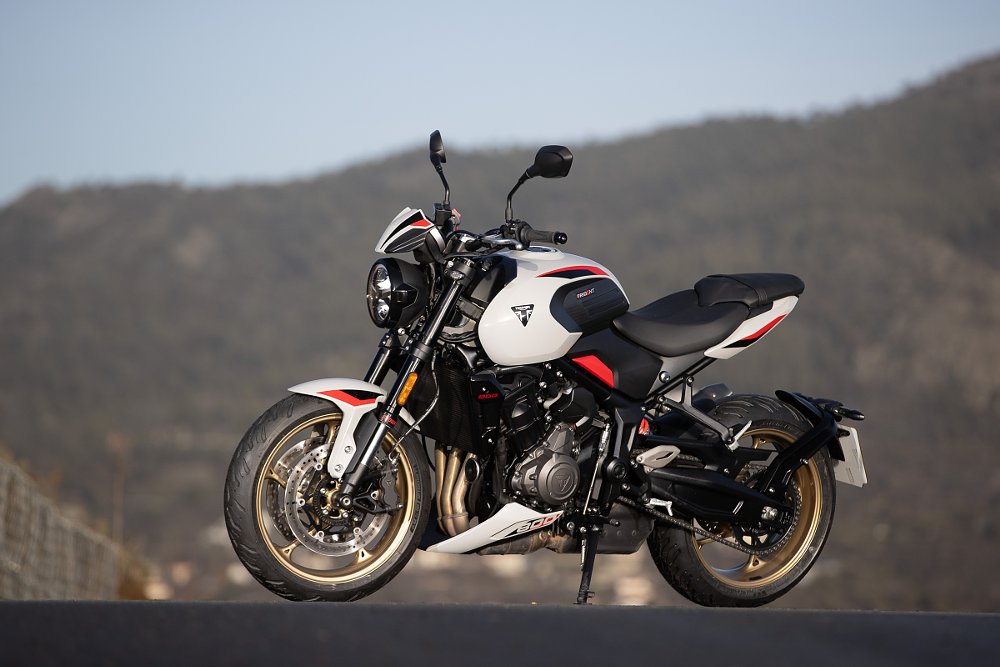
Summing up the 2026 Triumph Trident 800
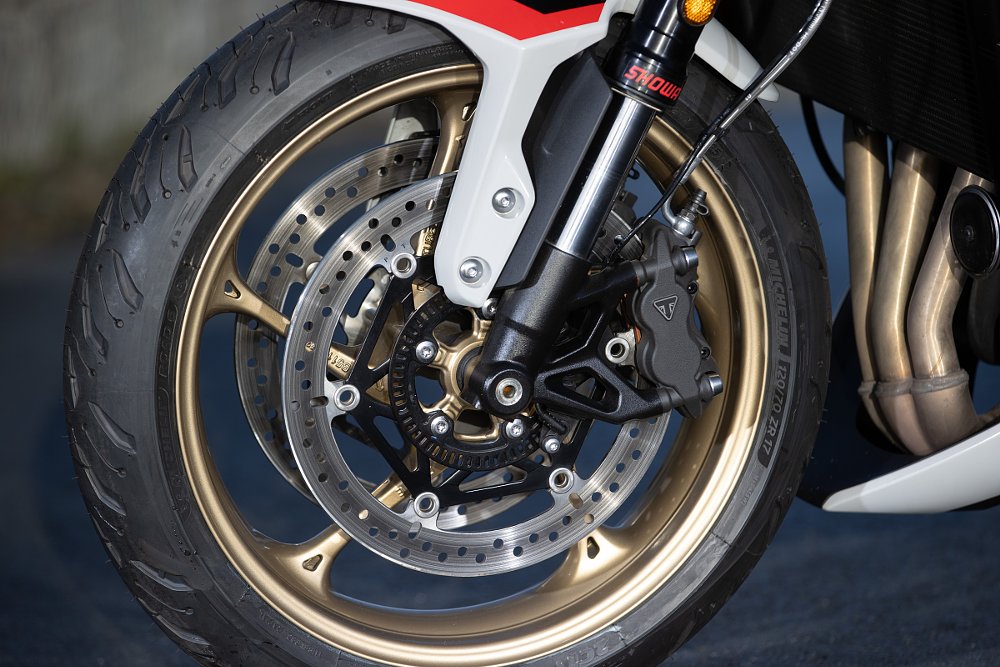
Starting from the top, the Trident 800's chassis is identical to that of the updated-for-2026 Trident 660 and existing Tiger Sport 800. Compared to the original Trident 660, the rear of the frame is constructed wider to accommodate a bigger airbox and one throttle body per cylinder, instead of just one throttle body for all three. Triumph says the chassis is "more sporty," and later informed me that the head angle is within 0.1 degrees of the original Street Triple 675 R's (although it noted the trail differs more significantly). Hardware wise, suspension is adjustable both front and rear by Showa (compression and rebound on the front, preload and rebound on the rear), brakes come almost entirely from J.Juan — and a sharp eye will note the front master cylinder is stamped Nissin. Tires are very appropriate Michelin Road 6s, which will no doubt please many and, based on my own experience, are an excellent choice on almost any road bike.
The usual riding tech is all there, but is intended to blend in as if it didn't exist. Rain, Road, and Sport modes form the menu and are selectable from the handlebar controls, with traction control and lift-control calibrated appropriately for each. ABS and traction control are, as you'd expect in 2026, lean-angle-sensitive, and wet mode retains full power. A bi-directional quickshifter comes as standard, as does cruise control, which I think are generous touches.
The 798 cc engine is lifted directly from the Tiger Sport 800, although is loaded with a slightly different tune, but is otherwise identical in terms of power, torque, gearbox ratios, and final drive. Peak horsepower is a claimed 113.4 at 10,750 rpm, and peak torque arrives at 61.9 foot-pounds at 8,500 rpm. Triumph didn't show a dyno graph in their presentation, which is somewhat unusual but also vaguely excusable given the context. However, it did claim that more power and torque are delivered below 5,000 rpm than by the outgoing Street Triple 765 R.
All this comes with a starting price of $9,995 in the United States. And by now, you've probably formed a picture in your mind of who's in mind to buy this bike, and what else they may be considering. If you pictured someone buying their second big bike, you'd be right, and if you supposed they might be considering Yamaha's MT-09, Kawasaki's Z900, or BMW's F 900 R, you'd also be spot on the mark. Triumph thinks the average buyer will be covering around 5,000 road miles per year.
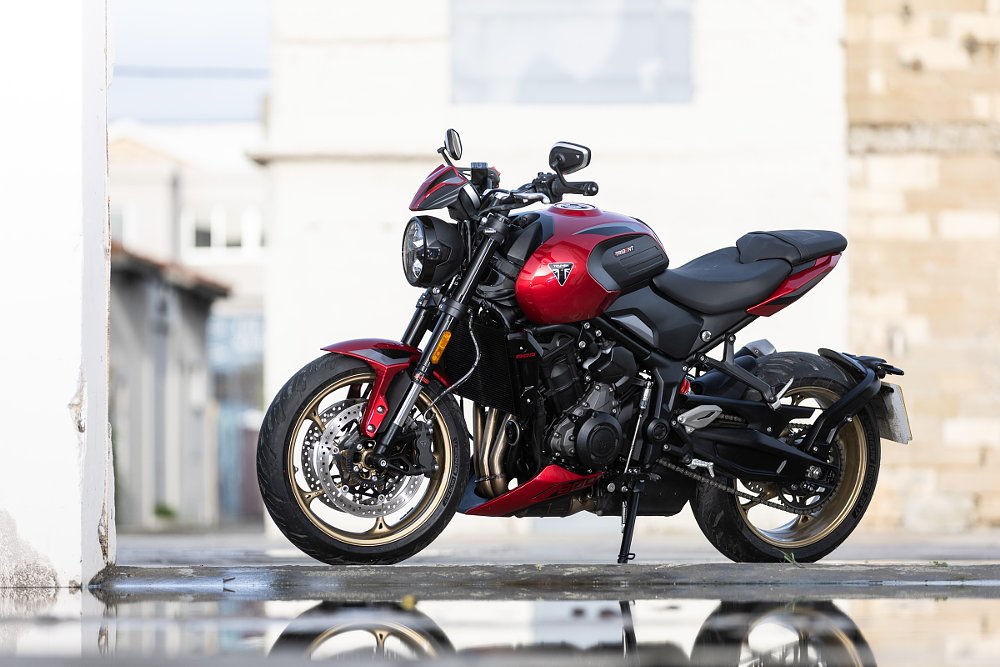
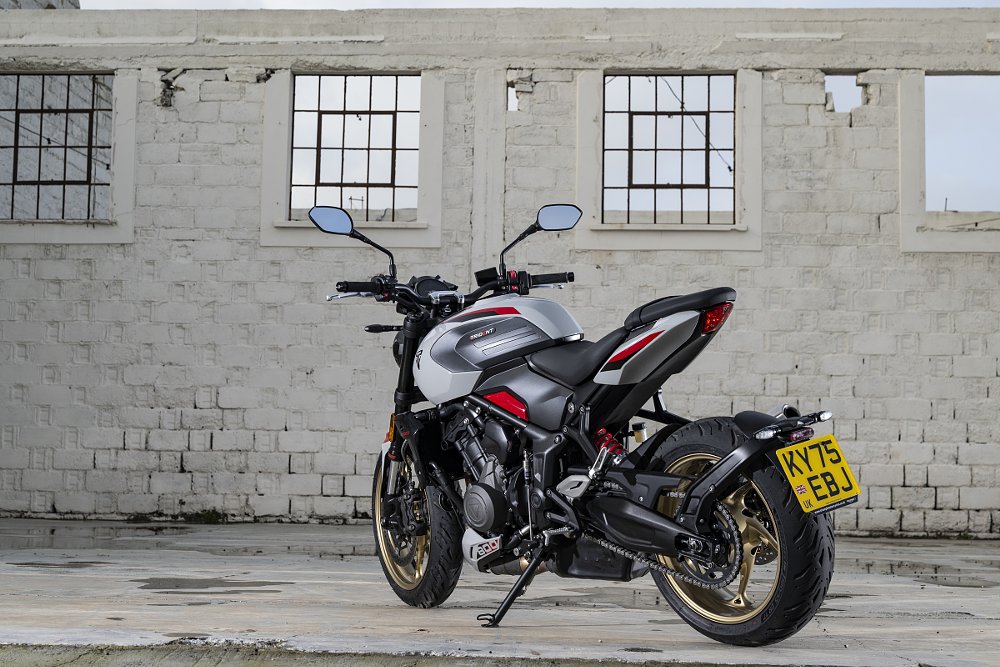
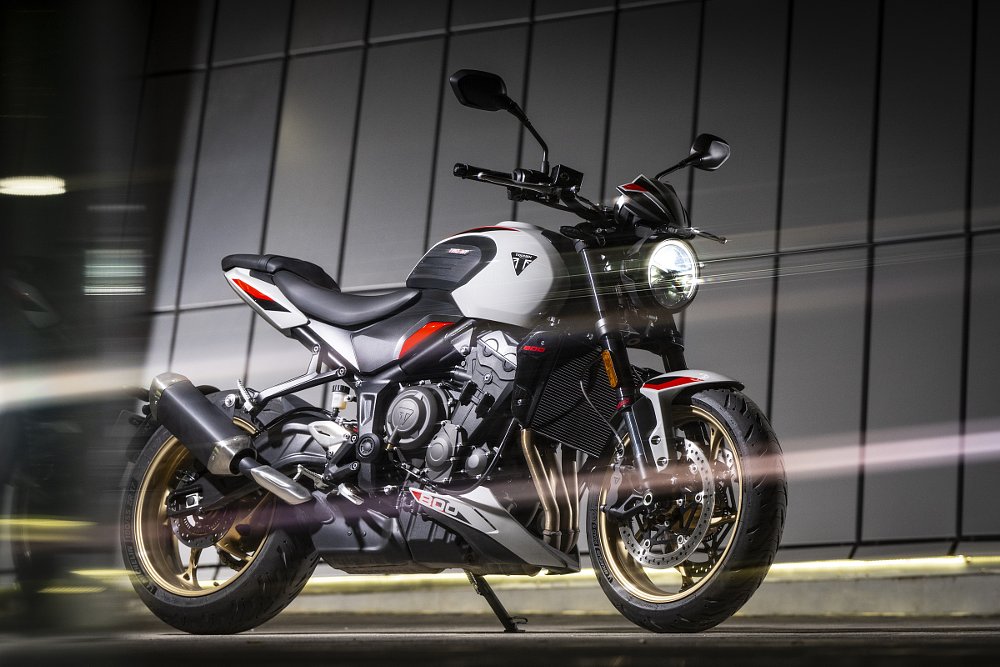
I think Triumph's ideas here more than pass the sniff test, and to me the rest of the Trident 800's specifications cash the check it's purporting to write. It's not intimidating yet holds presence, doesn't look like its competition, and only when you get up close and personal can you see how the $9,995 price tag was achieved. It is, after all, a bike built to an aggressive price point, and the things to point at while scratching your chin — such as some rather snotty welding under the head stock, the rudimentary cat-box-to-end-can exhaust arrangement, non-adjustable clutch lever, simplistic dashboard, and value-for-money brakes — are all fairly justified by the whole "Yeah, but it costs under 10 thousand!" These savings also allow it to come with the belly pan and cruise control as standard.
Riding the Triumph Trident 800
Jumping on reveals a narrow over-stance; the seat measures at 31.9 inches high, which suits my five-foot, 10-inch frame extremely comfortably and is within half an inch of the three named competitors. The weight (436.5 pounds wet) feels like it's held low in the chassis, and looking at the Trident 800, at least to my eyes, visibly confirms that when looking at the distance from terra firma to crankcase.
We'd rolled into town from the coastal outskirts, and in the very first few miles I found myself bouncing up and down on the seat and deciding the bouncy bits are definitely set up to be overwhelmingly soft and plush. I weigh in at around 170 pounds fully geared up, and I find it typically unusual to experience this much in the way of movement from my own weight alone. I wondered how this would work later on in the mountains, but it's admittedly decidedly well set up for town work and tackling the inevitable seams, bumps, and potholes, which all but disappear. First gear works well, the clutch is super light with a predictable bite and, pretty much, you can hack your way through traffic while winning arguments in your head, singing Taylor Swift songs, or whatever else. It's a cinch to ride in this environment and requires next to no thought. I didn't detect any heat from the cat box when sitting at stop lights, plus the mirrors offer a decent view past your elbows. So far so good: an amenable, smiley friend, but it was time to get a wriggle on.
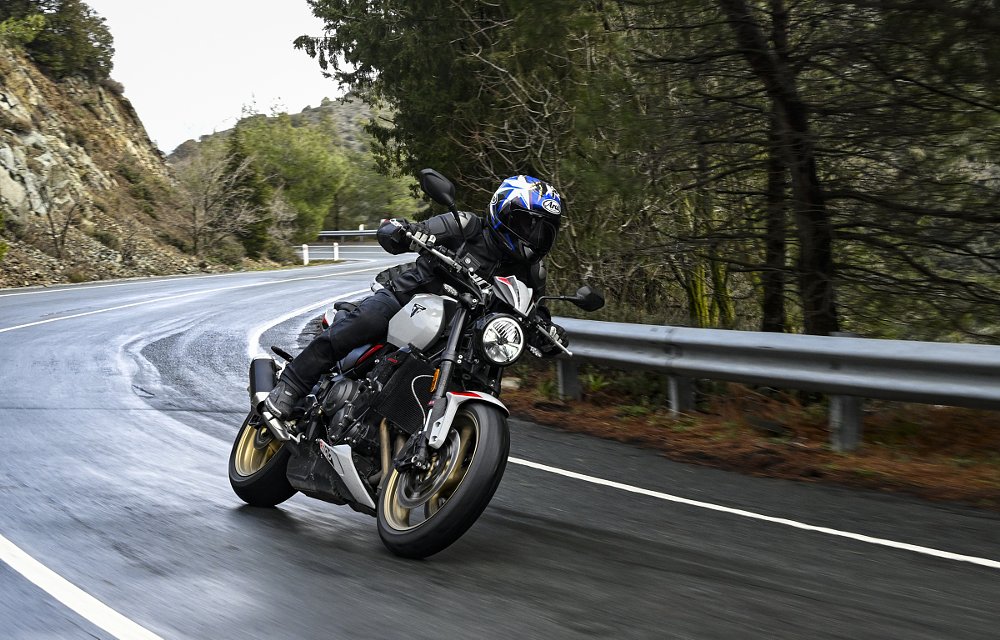
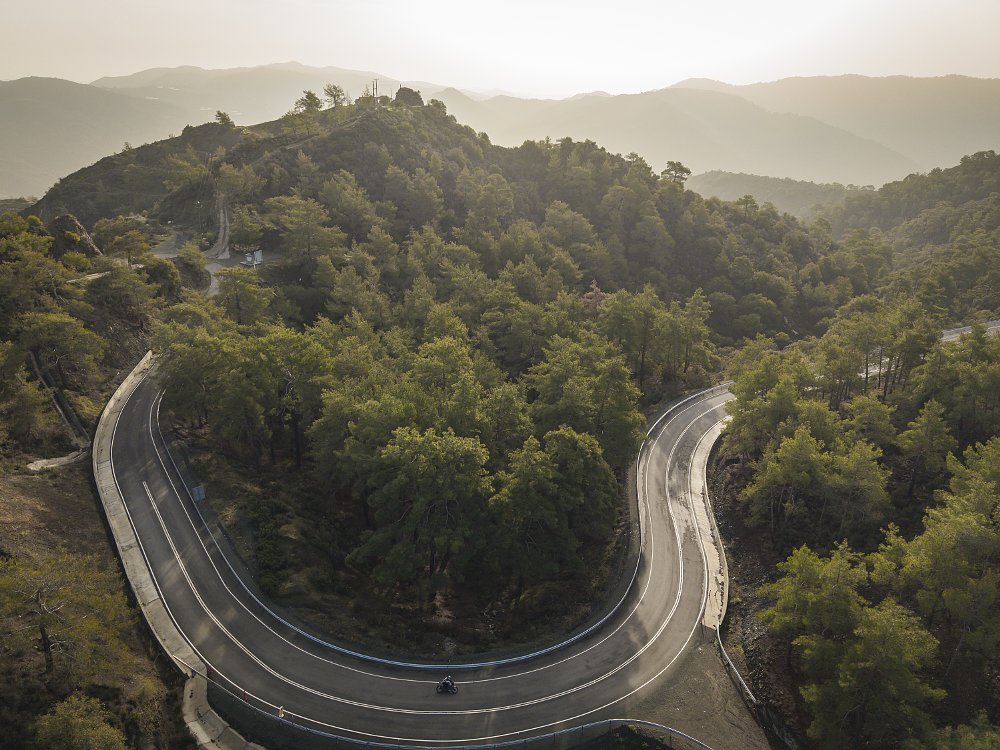
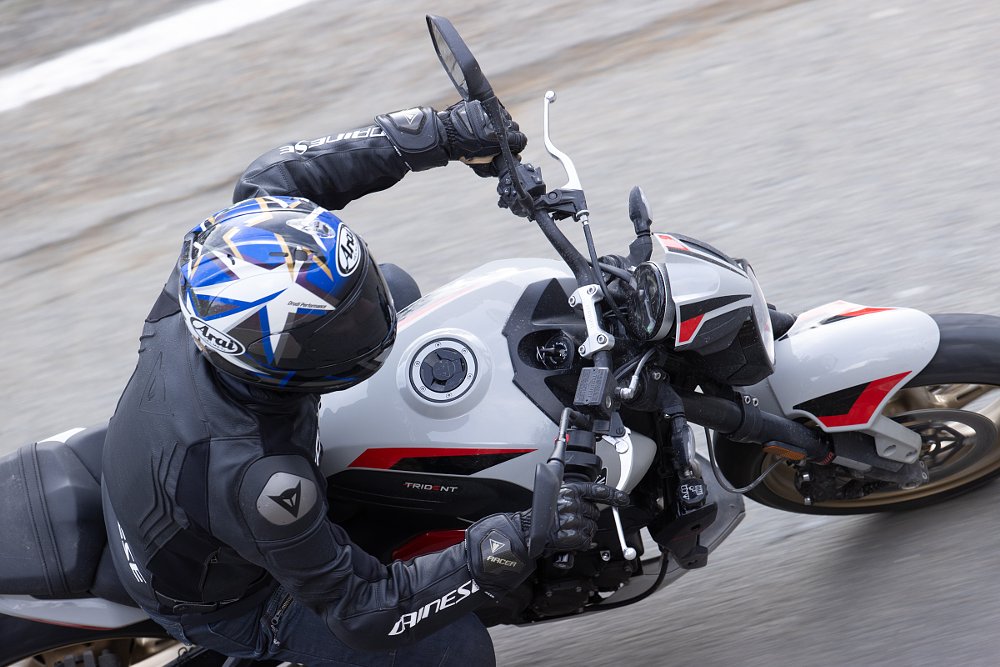
The route up towards the Troodos Mountains north of Limassol was somewhere between almost dry and damp-ish, so the pace had picked up a bit, but not considerably. I'd opted for Road mode; a quick venture into Sport revealed what I typically find, which is the delivery in that setting is designed for feel-good-fun vibes but ultimately sacrifices too much finer control. And I kind of valued a bit more control in the changeable surface conditions. With Road mode locked in, on the approach to a set of visibly dry bends nestled amongst a set of damp ones, I'd gotten the chance for a first proper haul on the anchors. From just that I'd filed the next mental note regarding J Juan's finest front brakes — good, but not great, a soft initial bite and overall not much feel. Hmm.
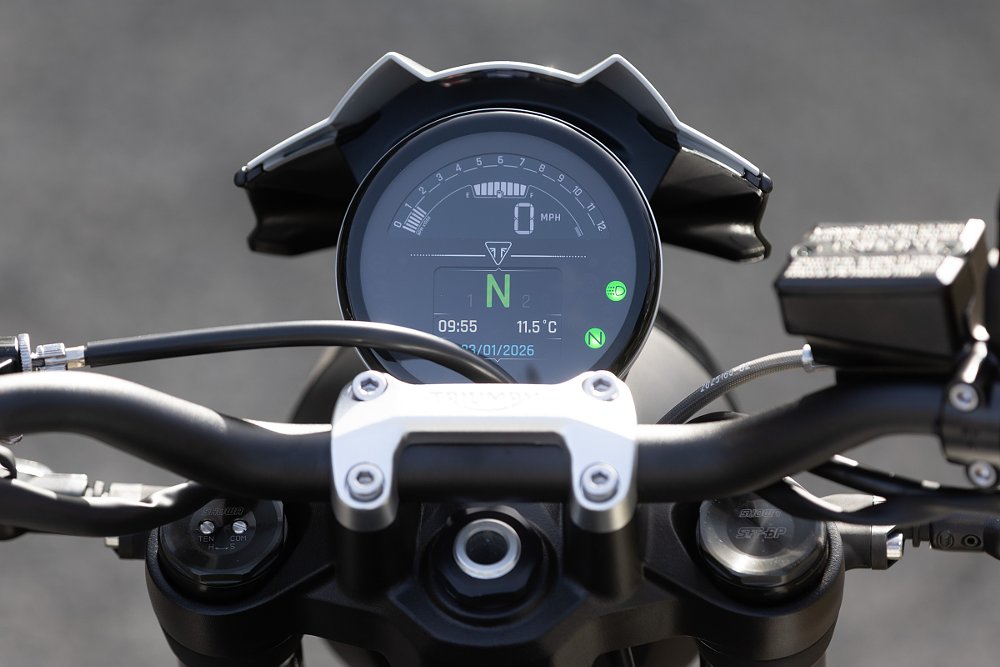
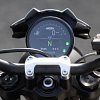
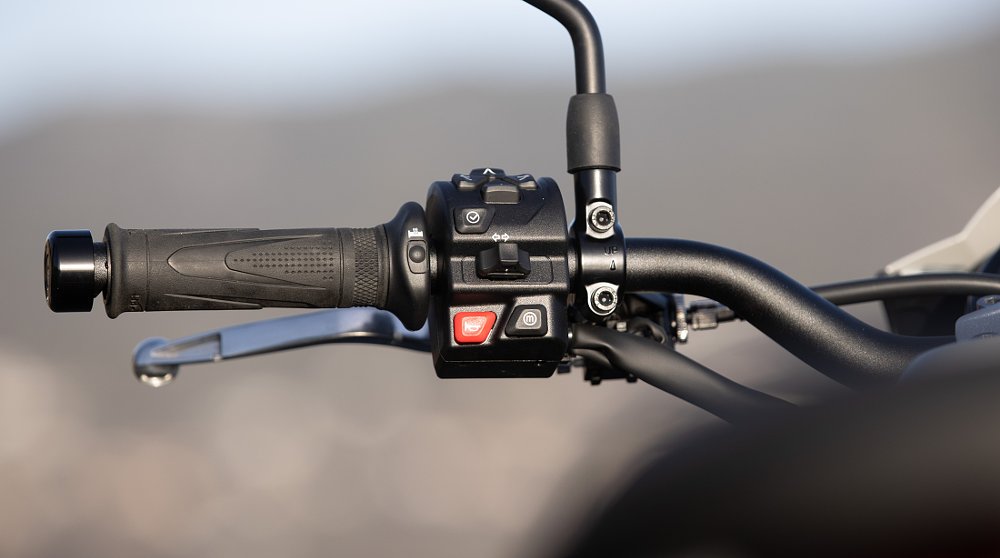
Allow me for a second to do my usual thing, which is to moan about Triumph's dashboard and handlebar controls. The dashboard is simple and it works. There's an LCD across the top half and a small, square TFT-type display at the bottom for displaying something of your choosing. Between the two you're given all you need to know, but crikey is it non-intuitive to operate from the lefthand 'bar. Up? Down? Left? Right? Which do I want to stab at to get… something else? Or back to where I was? Quite how Triumph has managed to build a pleasingly simple and effective display, and then mate it to an over-complicated array of six buttons with which to (attempt to) operate it is as equally as baffling as it is irritating. Triumph, you literally need about three buttons here, not six! You'd get used to Triumph's idea of "it works," no doubt, but elegant it is most certainly not.
I digress. Over a coffee stop I learnt that the quickshifter will allow you to change down even with a wide-open throttle, which when we got back out on the road I confirmed as true. Stuart Wood, Triumph's Chief Engineer, also commented the gearbox has been refined, but quite honestly I wouldn't have known. It's slick and works every time, whether you use the 'shifter or not. The ratios make sense, first is quite long, second is meaty, and the rest are likewise evenly stacked thereafter. First will top out at about 70 mph, which means you're in with a shout against anything in the game of stop light GP.
Post coffee and pre lunch, I'd had a bit of time to reflect on just how easy the riding seemed to be. I hadn't needed to think about the handlebar position, whether the foot pegs were just right or not, whether the seating position worked — because it all felt just right to start with. There's loads of torque on offer everywhere in the rev range and the exhaust spits a pleasing burble on the overrun. A few vibes say hello at around 6,000 rpm, but so far it could only be declared a ridiculously easy and naturally comfy place to spend time. It would be near impossible to be intimidated by the Trident 800. I'd kept in Road mode all the while, but with rapidly drying roads I'd decided to ask for a couple of clicks of extra preload at the rear to see if I could coax out some extra character.
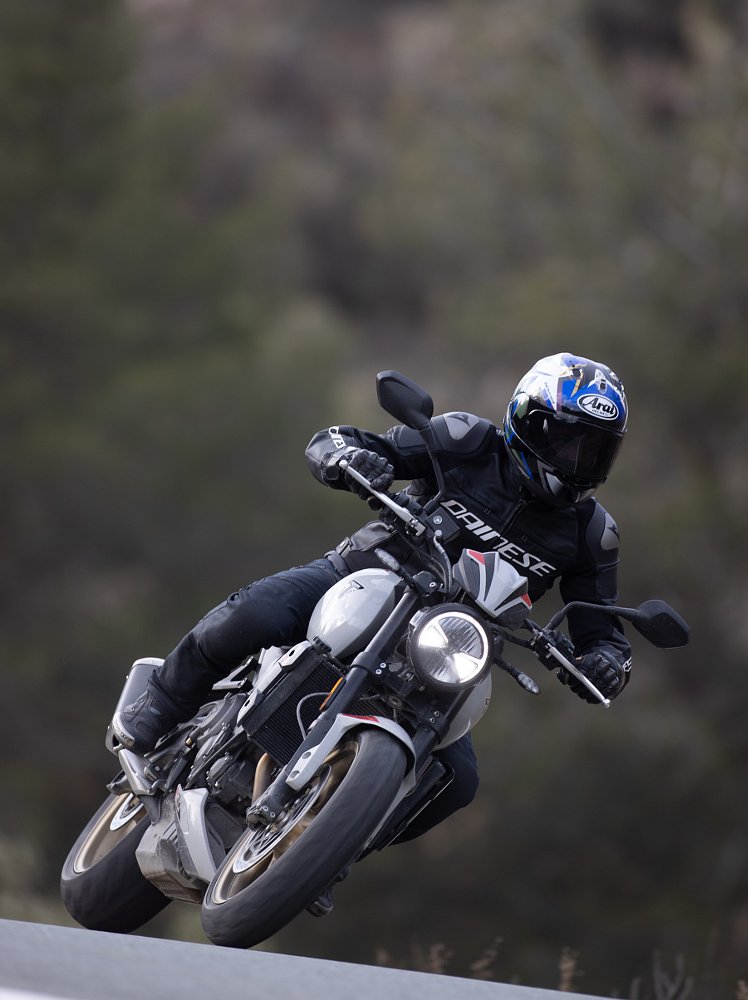
After lunch, the skies cleared and we were, at last, treated to fully dry roads, and that was the point at which my 2009 flashback happened. That was the "This is basically my Street Triple 675 R all over again" flashback, except with an even pokier motor. Grinning ear to ear, my senses wrapped in a cacophony of triple-cylinder roar, pinging from second to third gear and back again as a relentless set of perfect corners were fed one after another at me… pure joy, I must admit. In the moment, none of the minor annoyances mattered anymore, and even if I was wishing for an extra 500 rpm to play with, I was content. The extra preload on the rear had tightened things up and allowed the front wheel to paw at the air below it on full-throttle corner exits. Tip-in to corners was predictable and easy, and I felt like the chassis was communicating on behalf of the tires.
Rolling back into town, I had a little time to reflect. The previous 100 miles had showcased the entire point of a bike like the Trident 800. Easy to ride, not too serious, loads of fun when you want it to be, and comfortable to take on most anything thrown at it. Sure, it's not as tight as a Street Triple R (or RS, etc.) but it's not meant to be. Everything appears to match up — the brakes don't overwhelm the chassis, the suspension works well for the commute to work or the weekend canyon run, and there's plenty of capability for experienced riders, as well as growing room for those with fewer years of experience. All for a price tag that doesn't offend, while offering a bit of British character and a look different from the rest.
Is it as torquey as the MT-09? No. Is it as powerful as the Z900? Also no. Is the engine as up-for-it as BMW's F 900 R? Yes!
This is just a 100-miler first ride, and no doubt living with a Trident 800 would yield some new opinions, but to be honest, I just wanted to fill the tank up and go for another lap because the Trident 800 is summed up as such: bucket loads of fun, unintimidating, and extremely hard to fault.
| 2026 Triumph Trident 800 | |
|---|---|
| Price (MSRP) |
U.S.: $9,995 in Jet Black; $10,145 in Ash Grey or Carnival Red Canada: $11,695 in Jet Black; $11,845 in Ash Grey or Carnival Red |
| Engine | 798 cc, liquid-cooled, 12-valve, inline three-cylinder |
|
Transmission, final drive |
Six-speed, chain |
| Claimed horsepower | 113 @ 10,750 rpm |
| Claimed torque | 61.9 foot-pounds @ 8,500 rpm |
| Frame | Tubular steel perimeter |
| Front suspension | Showa Separate Function Fork Big Piston (SFF-BP) 41 mm fork, adjustable for rebound and compression damping; 4.72 inches of travel |
| Rear suspension | Showa RSU shock, adjustable for preload, rebound damping; 5.12 inches of travel |
| Front brake | Dual four-piston calipers, 310 mm discs with ABS |
| Rear brake | Single-piston caliper, 220 mm disc with ABS |
| Rake, trail | 24.5 degrees, 4.3 inches |
| Wheelbase | 55.2 inches |
| Seat height | 31.9 inches |
| Fuel capacity | 3.7 gallons |
| Tires | Michelin Road 6, 120/70R17 front, 180/55R17 rear |
| Claimed weight | 436.5 pounds wet |
| Available | April 2026 |
| Warranty | 24 months |
| More info | triumphmotorcycles.com |